 Skip to content

Choosing a corporate photography package is less about buying a block of camera time and more about deciding which business assets your team needs to put to work. For a San Antonio business, the useful question is not “How many hours?” first. It is: which images must support recruiting, sales, leadership visibility, the website, social channels, and any upcoming event—and what has to happen before, during, and after the shoot for those assets to stay usable?
This guide gives marketing, HR, communications, and event teams a scope-first way to compare proposals. It deliberately does not publish local price ranges: schedules, locations, production requirements, image rights, post-production, and delivery needs can change a quote materially. Instead, use the framework below to request comparable scopes before choosing a photographer.
Illustrative-media disclosure: the diagrams in this guide are original AI-assisted editorial illustrations. They explain planning concepts only and do not depict a Nitro client, project, or San Antonio location.
Put the right decision-makers in the brief
Corporate photography touches more than one department, so the brief needs a compact decision team before a provider is asked to price it. Marketing usually owns the destination list and brand references. HR or recruiting can identify the people and moments that should feel credible to candidates. Operations or an event lead can confirm access, timing, location constraints, and the day-of contact. A leader who can settle tradeoffs keeps the shoot from stalling when a priority person, room, or time window changes.
That does not require a committee on set. It requires one shared document, a named approver, and a clear escalation path. Ask each stakeholder to identify the two or three images that are most important to their work, then reconcile conflicts before the schedule is built. The result is a package brief that protects the assets a business will actually use instead of a long, unranked wish list.
Start with the business job, not a photography label
A “corporate photography package” can mean anything from a coordinated headshot day to a multi-location content shoot with executive portraits, workspace images, event coverage, and a delivery library. If the team starts with a label instead of an outcome, a proposal can look complete while still missing the images that matter after launch.
Begin by naming the places each image will appear. Recruiting may need warm team portraits and real work environments. Sales may need leadership images, customer-facing spaces, and a consistent library for decks. A website refresh may need wide banner crops, vertical social crops, and detail images that can carry a service page. An event may need a separate run of arrival, speaker, attendee, sponsor, and room-wide moments. Those are different jobs, even when they happen on one shoot day.

Use this simple outcome map before you ask for a quote:
| Business use | Image work that usually supports it | Decision to make before the proposal |
|---|---|---|
| Recruiting and careers | Team portraits, culture moments, workplace details | Which roles and environments should feel representative without staging a false story? |
| Website and brand refresh | Leadership, service process, locations, horizontal and vertical crops | Which pages need original imagery, and what crop formats do those placements require? |
| Sales and press | Executive portraits, meeting scenes, selected facility or product context | Who needs approved images, and which files must be ready for quick reuse? |
| Conference or company event | Room-wide context, speakers, attendee interaction, details, candid moments | What moments cannot be repeated, and who can identify priority people or sessions? |
That exercise also separates a package from a single headshot session. If your immediate need is a consistent portrait for each employee, start with the narrower corporate headshot planning guide. If you need a reusable library that answers several business jobs, your brief needs more than a per-person portrait count.
Build the package scope in five connected parts
A useful proposal makes the work visible before the camera arrives. The five connected parts are coverage, production logistics, post-production, image rights, and delivery. A weakness in one part can undercut the others: a strong shoot day is less useful if no one agreed which crops are needed, who approves final selects, or where files will live.
1. Coverage and subject priority
List the people, spaces, activities, and event moments that matter. Include a priority level rather than treating every requested image equally. A good brief protects time for the few images that must work while leaving room for spontaneous moments that are genuinely useful. It also tells the photographer what not to overproduce. For example, an office refresh may need five specific service scenes but not a large set of generic hallway photographs.
2. Production logistics
State the number of locations, access windows, group sizes, room availability, wardrobe expectations, parking or loading notes, and the person empowered to make a decision on the day. For a San Antonio-wide request, list every address and any building or event constraints rather than assuming the locations are operationally interchangeable. This is a planning detail, not a promise about travel or permit requirements.
3. Post-production and selection
Ask how the team will review proofs, who selects finals, what kinds of retouching are included, and how revisions are handled. “Editing included” is too vague on its own. Your comparison should distinguish basic global correction, portrait retouching, compositing, and the turnaround needed for time-sensitive event or press use.
4. Usage and permissions
Ask where the business expects to use the images: owned website pages, organic social, recruiting, sales presentations, paid promotion, partner distribution, print, or press. Photography is an original work of authorship that may be protected by copyright; a company should read its agreement for the rights it actually receives rather than assuming possession of files answers every use question. The U.S. Copyright Office’s FAQ is a useful starting point on what copyright protects, not a substitute for legal advice.
5. Delivery and stewardship
Set the delivery format, naming convention, gallery or folder owner, expected file sizes, and the person responsible for distributing approved assets. A folder of hundreds of unlabeled files is not a usable corporate library. Ask for a handoff that lets a marketing teammate identify an approved headshot, a web-ready wide image, or an event recap image without reopening every file.
Turn business needs into a shot list people can use
A shot list should not become a script that removes all judgment from the shoot. It should be a shared decision tool: it helps the client explain what matters, gives the photographer a clear order of operations, and makes gaps visible before people are unavailable or a room changes.
Organize the list by categories that map to your actual use cases. People can include headshots, leadership, teams, and customer-facing staff. Spaces can include exterior context when appropriate, reception, meeting rooms, production areas, or retail/service environments. Process can include preparation, collaboration, service delivery, or an approved behind-the-scenes moment. Details can include tools, branded materials, hands at work, or environmental textures. Events can include speakers, audience, networking, awards, and key attendees.

For every priority item, add four notes: intended destination, subject or location, preferred orientation, and approval owner. “Leadership portrait for the About page; horizontal and vertical; marketing director approves” is actionable. “Get executive photos” is not. If a person is unavailable, a room cannot be photographed, or an event schedule moves, the team can then make a real tradeoff instead of discovering a gap after delivery.
Keep the list tied to the assets that will be updated. If the website will not be redesigned for six months, do not let a hypothetical homepage image displace an immediate recruiting or sales need. Conversely, if a brand refresh is the reason for the shoot, share page wireframes or crop needs early. The photographer does not need a final design system to plan a useful range of horizontal, vertical, and detail frames.
Compare proposals on the same terms
Do not compare two proposals only by total price, hours, or image count. Those labels can conceal different assumptions. Instead, ask each provider to respond to the same brief and place the answers in one comparison sheet. The goal is not to make every proposal identical; it is to learn what is different before you commit.
| Compare this | What a clear proposal should say | Why it changes the decision |
|---|---|---|
| Coverage window | Locations, time blocks, priority subjects, planned breaks, event moments | Shows whether the schedule can actually cover the requested assets |
| Deliverables | Selection process, estimated final library, file formats, crop variants, gallery access | Prevents a mismatch between what is captured and what a team can publish |
| Post-production | Included correction, retouching boundaries, revisions, turnaround | Separates a workflow promise from a vague “edited images” statement |
| Usage and approvals | Planned channels, agreement terms, approver, release needs | Reduces later uncertainty around reuse and sign-off |
| Contingency | Weather, unavailable people, location changes, timeline change process | Reveals how the team handles a real production constraint |
Ask providers to identify assumptions rather than forcing false certainty. If a proposal assumes one location, one setup, a standard turnaround, or client-supplied releases, that is useful information. The wrong response is not necessarily a deal-breaker; it may be a signal to add a line item, change the plan, or choose a different scope.
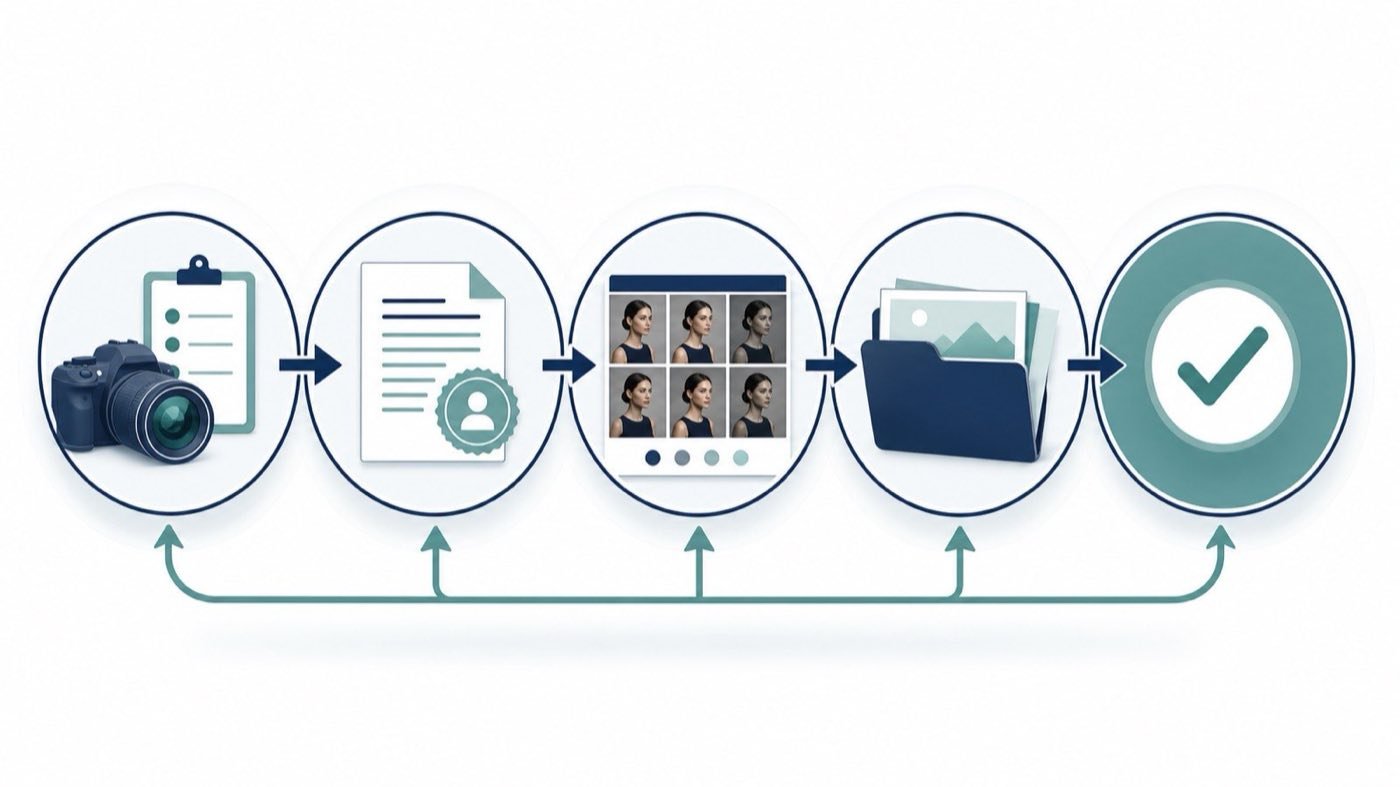
It is also reasonable to ask what will be handed off at the end: final files, web derivatives, a searchable gallery, usage notes, and a concise summary of what was selected. Treat the answer as an operating handoff for the people who will publish the imagery, not just a transfer of files.
Prepare a San Antonio-ready brief without inventing local detail
Local relevance should change the request, not simply add a city name to the title. A San Antonio organization may have an office, venue, event, warehouse, or service location that needs to be represented accurately. Put the real locations, access instructions, time windows, and on-site contacts in the brief. If a place cannot be shown, say so. If a team wants to include a recognizable local context, confirm the business purpose and permissions instead of using a generic city backdrop.
When you contact a provider, the useful first message is concise: what the organization is trying to accomplish, which locations are involved, the priority coverage categories, who approves the work, the intended publish channels, and the desired delivery window. That gives the provider enough context to respond with a tailored scope rather than a generic hourly estimate.
For broader production planning, Nitro’s corporate photography planning overview can help a team frame why original images matter. When your package needs a production partner rather than a one-off asset, review the relevant Nitro services and bring the same scope brief to the conversation.
Questions to settle before booking
- What has to be true after the shoot? Name the pages, campaigns, roles, or event recap that need usable imagery.
- Which people and spaces are non-negotiable? Prioritize subjects whose availability cannot be recreated later.
- What should the photographer know before arriving? Provide locations, access, wardrobe guidance, schedule, brand references, and approval owner.
- How will we select and receive final files? Decide who reviews proofs, what turnaround is needed, and where approved files will live.
- Where do we expect to use the images? Discuss intended channels and confirm the agreement covers the planned use.
- What could change on the day? Record a simple decision path for schedule shifts, unavailable subjects, weather, or location constraints.
The best package is the one that makes the next business action easier. A small team may need a tightly managed headshot day and a handful of workplace images. A growing company may need a reusable library across recruiting, web, sales, and leadership. An event team may need a focused coverage plan built around moments that cannot be repeated. A comparable brief lets you choose the right level of production support without pretending every business needs the same package.
Sources and scope notes
- U.S. Copyright Office: What Does Copyright Protect? — used for the limited statement that original photographs may be protected; review your own agreement for actual rights.
- JF Photos: What Is a Corporate Photography Package? — consulted as a current competitor-format example for common scope categories; its price ranges and provider-specific claims are not used as San Antonio market facts.
- Nitro corporate headshot planning and Nitro corporate photography planning — internal next steps for related but distinct reader jobs.


