 Skip to content
2026 Update: DeepSeek vs ChatGPT Changed Because DeepSeek Changed
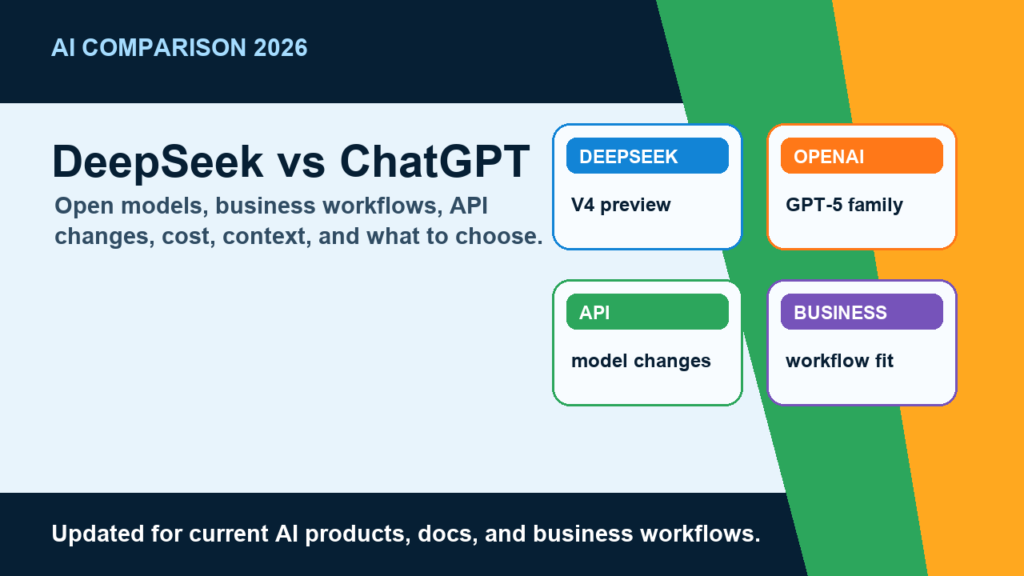
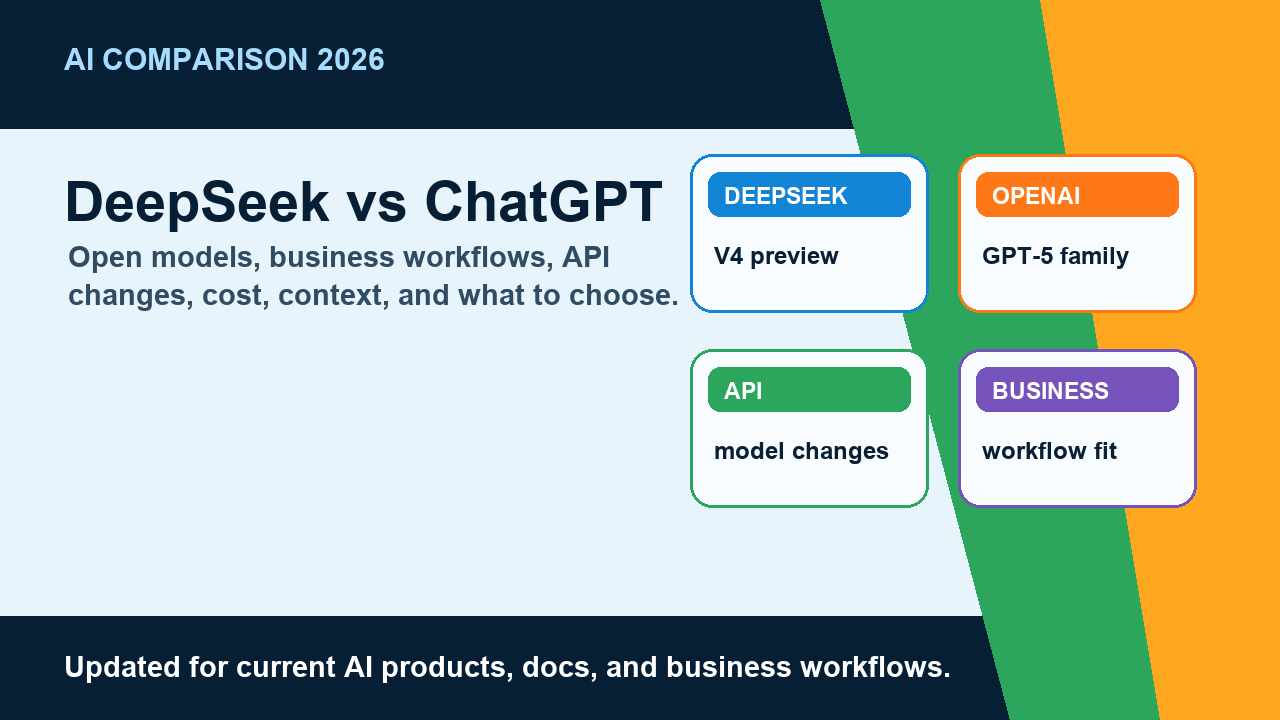
Fast answer: the DeepSeek vs ChatGPT comparison is no longer just “cheap open model vs polished closed model.” DeepSeek’s official docs now highlight DeepSeek-V4 Preview, 1M context, OpenAI/Anthropic API compatibility, and retirement dates for older model names. ChatGPT/OpenAI, meanwhile, has moved deeper into GPT-5, GPT-5.5, Business workspaces, Codex, connectors, and agent workflows.
| Decision point | DeepSeek | ChatGPT / OpenAI | Nitro take |
|---|---|---|---|
| Model direction | DeepSeek-V4 Preview pushes open-source/cost-effective long-context models. | OpenAI GPT-5 and GPT-5.5 emphasize broad product/work capability. | DeepSeek is compelling for builders and cost-sensitive API work; ChatGPT is cleaner for teams that need a polished workspace. |
| API changes | DeepSeek says older deepseek-chat and deepseek-reasoner names are being retired. | OpenAI model names also evolve, but ChatGPT users are shielded by product surfaces. | API users must track versioning. Casual users care more about product quality. |
| Context/cost | DeepSeek’s V4 docs emphasize 1M context and economy. | OpenAI emphasizes model capability, tools, Business/Enterprise, and Codex. | Run the math on your actual workload, not somebody’s screenshot of a token price. |
| Business adoption | Best when technical teams can own evaluation, privacy, hosting, and workflow fit. | Best when teams need managed tools, admin controls, and broader nontechnical adoption. | The better tool is the one your team can safely use every week. |
Which Should A Business Choose?
| Business need | Likely better fit | Why |
|---|---|---|
| Nontechnical team productivity | ChatGPT Business | Cleaner user experience, admin controls, connected apps, and workspace context. |
| High-volume API experiments | DeepSeek | Cost, model openness, and API compatibility can be compelling if your team can manage it. |
| Coding/agent workflows | Test both | Use real repo tasks, not benchmark vibes. |
| Compliance-sensitive work | Depends | Review data handling, region, hosting, contractual terms, and admin controls before choosing. |
Straight up: DeepSeek can be a very smart technical choice. ChatGPT can be a very smart organizational choice. The mistake is pretending one answer fits every business just because a leaderboard got loud.
Sources Checked For This 2026 Refresh
| Source | Why it matters |
|---|---|
| DeepSeek V4 Preview | Current DeepSeek model direction and API notes. |
| DeepSeek model list | Current available models endpoint documentation. |
| DeepSeek pricing / model retirement note | Deprecation dates and model alias notes. |
| OpenAI GPT-5 | Current OpenAI model/product framing. |
| ChatGPT Business | Team workspace context. |

Choosing the right AI solution for your business depends on your priorities. DeepSeek AI offers a cost-effective, open-source model that prioritizes data privacy and excels in technical tasks. Its affordability makes it a strong contender for startups and small businesses. On the other hand, ChatGPT, backed by OpenAI’s resources, shines in creative and conversational applications. Businesses seeking customer engagement or content creation often favor ChatGPT. Interestingly, DeepSeek AI and its market impact have disrupted traditional AI models, proving that innovation doesn’t always require massive budgets.
Have you used DeepSeek AI or OpenAI’s ChatGPT? Let us know which you prefer.
Key Takeaways
-
DeepSeek AI is cheaper than ChatGPT. It costs $0.14 per million tokens, while ChatGPT costs $7.50. This makes DeepSeek great for small businesses and startups.
-
DeepSeek AI is better at technical tasks like coding and solving math problems. It scores high in tests. ChatGPT is better for creative writing and conversations.
-
DeepSeek AI is open-source, so you can use it locally. This keeps your data safer. ChatGPT uses external servers, which may not be as private.
-
If your business needs customer interaction or content creation, ChatGPT is a better choice. It creates interesting text and answers questions well.
-
Pick DeepSeek AI if you care about cost and technical work. Choose ChatGPT if you need creativity and good conversation skills.
Cost Comparison
API Pricing
For startups and small businesses, this affordability can make a substantial impact. Lower API pricing allows you to allocate resources to other critical areas of your business while still leveraging advanced AI capabilities.
Development and Training Costs
DeepSeek AI’s development and training costs are another area where it stands out. The V3 model required an investment of approximately $5.58 million, with total development costs ranging from $5.6 to $6 million. This is a fraction of the tens of millions to $1 billion spent on ChatGPT’s development.
This cost efficiency directly translates to better ROI for businesses. If you’re a small or medium-sized enterprise, DeepSeek’s lower training costs make it a more accessible option. ChatGPT’s higher development costs often result in premium pricing for its advanced features, which may limit its accessibility for businesses with tighter budgets.
Accessibility and Subscription Fees
DeepSeek AI offers free access for most use cases, making it an excellent choice for businesses prioritizing cost-efficiency. Its open-source nature further enhances its accessibility, allowing you to deploy it locally without additional subscription fees.
On the other hand, ChatGPT provides a premium tier at $20 per month. While this subscription unlocks advanced features, it can become a barrier for smaller companies. For businesses seeking to minimize expenses, DeepSeek’s affordability and flexibility provide a clear advantage.
Tip: If your business requires large-scale AI implementations, DeepSeek’s cost-effective solutions can help you achieve your goals without straining your budget.
Performance and Features
Strengths in Technical Tasks
DeepSeek AI: Excels in coding, logical reasoning, and mathematical equations.
DeepSeek-Coder further enhances its technical capabilities by excelling in:
-
Code completion across 338 programming languages.
-
Debugging complex codebases.
-
Long-context support for managing extensive projects.
These features make DeepSeek a reliable choice for businesses in technical industries. Its ability to handle large-scale coding and problem-solving tasks ensures high performance in demanding scenarios.
ChatGPT: Performs adequately but not as strong in technical tasks.
OpenAI’s ChatGPT performs well in technical tasks but does not match DeepSeek’s precision in coding or mathematical problem-solving. While it offers general support for technical queries, its focus leans more toward creative and conversational applications.
Strengths in Creative and Conversational Tasks
DeepSeek AI: Limited capabilities in creative outputs.
DeepSeek’s primary focus on technical tasks limits its ability to generate creative content. It performs adequately in structured outputs but lacks the versatility needed for imaginative or conversational tasks.
ChatGPT: Superior in conversational and creative outputs.
ChatGPT excels in creative and conversational tasks, making it a consumer-focused large-language model. It generates coherent, contextually relevant text across various topics. Businesses often use it for customer support, blog writing, and social media content.
ChatGPT’s ability to create engaging stories, poems, and product descriptions sets it apart. Its natural language processing capabilities make it ideal for conversational AI applications.
Benchmarks and Rankings
DeepSeek AI: R1 and V3 models ranked in the top 10 on Chatbot Arena.
DeepSeek consistently ranks among the top performers in AI development benchmarks. Its R1 model surpasses ChatGPT in advanced math and coding tests. It also achieves competitive results in:
-
MATH-500
-
SWE-bench Verified
-
GPQA Diamond (graduate-level science)
-
MMLU (general knowledge)
These rankings highlight DeepSeek’s dominance in technical and reasoning tasks.
ChatGPT: Maintains a strong reputation but lacks specific benchmark details.
ChatGPT remains a popular choice for businesses due to its established reputation. While it performs well in general benchmarks, it does not provide detailed rankings in specific technical areas. Its strength lies in its versatility as a chatgpt-like AI model for creative and conversational use cases.
Accessibility and Privacy
Open-Source vs Cloud-Based Models
DeepSeek AI: Open-source, allowing local deployment and data privacy.
DeepSeek AI’s open-source nature gives you unparalleled control over its deployment. You can run it locally, ensuring your sensitive data stays within your infrastructure. This approach eliminates reliance on external servers, reducing the risk of data breaches. Open-source models like DeepSeek AI also allow developers to modify and scale the system at a lower cost, making it ideal for businesses with limited budgets.
This flexibility fosters innovation, especially for small and medium-sized enterprises (SMEs). However, open-source models may face challenges like potential biases or misuse by malicious actors.
ChatGPT: Cloud-based, requiring internet access and raising potential privacy concerns.
ChatGPT operates as a cloud-based solution, which means you need an internet connection to access its features. While this model offers seamless scalability through OpenAI’s infrastructure, it raises privacy concerns. Sensitive business data processed on external servers could be exposed to risks like prompt injection attacks or data leaks. Additionally, subscription-based pricing may limit accessibility for cost-sensitive users.
Data Privacy and Security
DeepSeek AI: Ensures data privacy by running locally.
When you use DeepSeek AI, your data remains secure within your local environment. This setup minimizes the risk of unauthorized access or data leakage. Businesses handling confidential information, such as financial or healthcare data, benefit significantly from this level of control. However, ethical concerns arise regarding the misuse of open-source models, as malicious actors could fine-tune them for unethical purposes.
ChatGPT: Data is processed on OpenAI’s servers, raising privacy questions.
Using ChatGPT involves sharing your data with OpenAI’s servers, which introduces several risks. For instance:
-
Sharing sensitive business data poses risks due to unclear privacy policies.
-
Prompt injection attacks can reveal previous instructions, compromising security.
-
Employees may inadvertently share sensitive information, with studies showing that 11% of inputs into ChatGPT contain confidential data.
-
Prompt injection attacks can manipulate user inputs, leading to potential data leaks.
-
Privacy breaches may occur if the model inadvertently reveals sensitive information.
-
Data leakage can happen when the model exposes training data or past interactions.
To mitigate these risks, you must educate your team on what information should not be shared with ChatGPT.
Business Use Cases
Scenarios Where DeepSeek AI Excels
Technical industries requiring coding, logical reasoning, or mathematical problem-solving.
DeepSeek stands out in industries that demand precision and technical expertise. Its advanced capabilities make it a valuable tool for solving complex problems. For example, financial services can use it for data analysis and financial modeling. In education, it supports STEM-related problem-solving tasks. Software developers benefit from its coding assistance and debugging features, while researchers rely on it for data analysis and research tasks.
DeepSeek also excels in specific use cases like sentiment analysis tools, image recognition, and language-based interfaces. These applications enhance customer feedback processing, inventory management, and software development. Businesses in technical fields can integrate DeepSeek into their workflows to improve efficiency and accuracy.
Businesses prioritizing cost-efficiency and data privacy.
If your business values affordability and data security, DeepSeek offers a compelling solution. Its open-source nature allows you to deploy it locally, ensuring sensitive data remains within your control. This feature is especially beneficial for industries like healthcare and finance, where privacy is critical. Additionally, its cost-effective pricing structure makes it accessible for small and medium-sized enterprises. By choosing DeepSeek, you can achieve high performance without exceeding your budget.
Scenarios Where ChatGPT Excels
Customer support, content creation, and conversational AI applications.
ChatGPT shines in creative and conversational tasks, making it ideal for customer-facing roles. Businesses like Spotify and Duolingo use it to provide multilingual customer support, enhancing user experiences. Octopus Energy employs GPT-powered chatbots to handle nearly half of customer inquiries, reducing the need for human intervention. Salesforce integrates ChatGPT to draft personalized emails, while Koo and Runway leverage it for social media content creation and video script generation.
ChatGPT’s versatility extends to tasks like workflow automation, document generation, and translation services. Its ability to create engaging content and handle customer inquiries efficiently makes it a preferred choice for businesses focused on customer engagement and brand building.
Businesses valuing creative outputs and established reputations.
If your business prioritizes creativity and a proven track record, ChatGPT is a strong contender. Its natural language processing capabilities allow it to generate high-quality content for blogs, social media, and marketing campaigns. Additionally, its established reputation ensures reliability and trustworthiness. By integrating ChatGPT, you can enhance your brand’s voice and connect with your audience effectively.
Market Impact and Challenges
DeepSeek AI and Its Market Impact
DeepSeek AI has significantly influenced the AI industry, challenging traditional norms and reshaping global benchmarks. Its rise has disrupted the market in several ways:
-
DeepSeek AI caused a 17% drop in Nvidia’s stock value, highlighting its impact on the tech sector.
-
The model’s performance at lower costs has reshaped industry standards, intensifying the global race for AI dominance.
-
DeepSeek AI became the top free app on Apple’s AppStore, reflecting strong consumer interest.
-
Investor Marc Andreessen praised it as a breakthrough, showcasing its recognition within the industry.
DeepSeek AI’s success demonstrates that innovation does not always require extensive resources. For example, China achieved better operations-per-watt efficiency in DeepSeek models compared to U.S. counterparts, even under chip restrictions. This shift has prompted a reevaluation of AI investment strategies and highlighted the growing competition to U.S. dominance in AI.
The emergence of DeepSeek AI also signals a shift toward decentralized AI growth. Nearly half of new Chinese AI startups now focus on edge and embedded systems. This trend emphasizes the importance of cost-effective and efficient AI development, further solidifying DeepSeek AI and its market impact.
Challenges and Skepticism
DeepSeek AI: Skepticism about cost claims and long-term adoption in the U.S.
Despite its achievements, DeepSeek AI faces challenges in gaining long-term adoption in the U.S. market. Ethical concerns about potential misuse of its open-source technology may deter organizations. Additionally, sustainable funding remains a critical issue. Without a proprietary revenue model, maintaining AI development and operations could become difficult.
Transparency is another hurdle. DeepSeek AI must align with regulations and establish clear operational guidelines to build trust, especially in politically sensitive environments. These challenges highlight the complexities of competing with established solutions like ChatGPT.
ChatGPT: Higher costs and limited accessibility for free users
ChatGPT also faces its share of challenges. Its higher costs can limit accessibility for smaller businesses. Free users can send only about five messages every 5-6 hours, which restricts its effectiveness. Moreover, ChatGPT sometimes generates responses lacking contextual relevance, requiring human oversight.
The reliance on cloud-based infrastructure raises privacy concerns, as sensitive data is processed on external servers. Businesses must weigh these limitations against ChatGPT’s strengths in creative and conversational tasks.
Both DeepSeek AI and ChatGPT face unique challenges, but their market presence continues to shape the future of AI solutions.
FAQ
What makes DeepSeek AI more cost-effective compared to ChatGPT?
DeepSeek AI offers significantly lower API pricing at $0.14 per one million tokens, compared to ChatGPT’s $7.50. Its open-source nature eliminates subscription fees for most use cases, making it ideal for businesses with tight budgets.
Can I deploy DeepSeek AI locally for better data privacy?
Yes, DeepSeek AI’s open-source model allows local deployment. This ensures your sensitive data remains secure within your infrastructure, reducing risks associated with cloud-based solutions.
What industries benefit most from DeepSeek AI compared to OpenAI’s ChatGPT?
Industries like finance, education, and software development benefit from DeepSeek AI’s technical strengths. In contrast, ChatGPT is better suited for creative tasks like content creation and customer support.
How does the DeepSeek model rollout impact the AI market?
The DeepSeek model rollout has disrupted the AI market by proving that innovation doesn’t require massive budgets. Its cost-effective development has intensified global competition, challenging traditional AI investment strategies.


