 Skip to content
GEO sounds new because the acronym is new. The actual work is not as mysterious as the pitch decks make it seem.
Generative engine optimization, answer engine optimization, AI search optimization, AI visibility, answer visibility, whatever label a vendor is using this month, the practical question is the same: can Google find your page, understand it, trust it enough to show it, and see something useful enough to connect with a real searcher’s question?
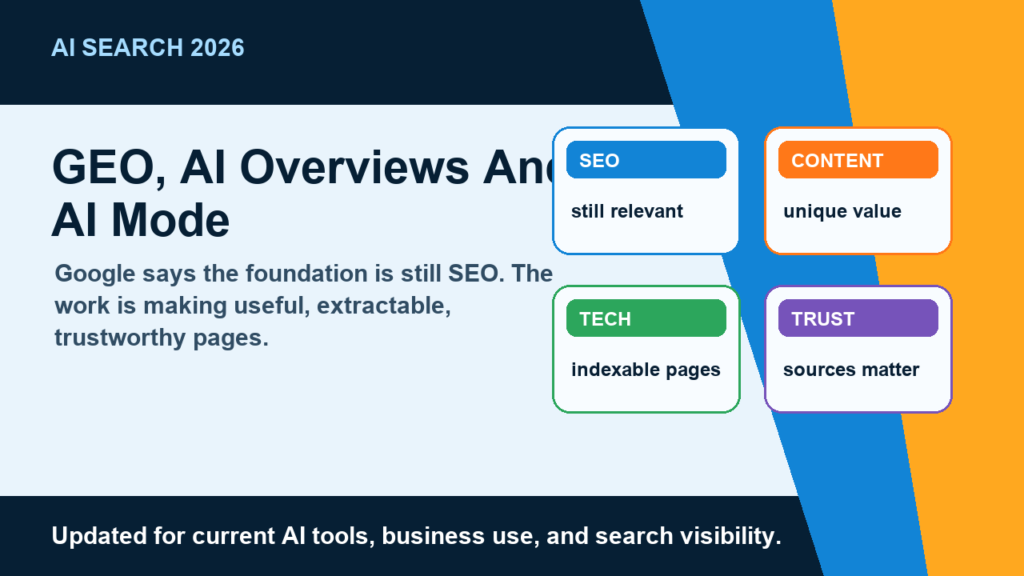
Google’s official guidance is pretty direct here. SEO is still relevant for generative AI experiences in Google Search. AI Overviews and AI Mode are not separate worlds where the old fundamentals disappear. Google’s generative AI features are tied to Search’s core ranking and quality systems, and Google says pages need to be indexed and eligible for snippets to appear as supporting links in AI Overviews or AI Mode.
That means the 2026 answer is not “stop doing SEO and start doing GEO.” The better answer is: keep doing real SEO, clean up the technical mess, publish content that has a reason to exist, and be careful with third-party advice that promises secret AI visibility tricks.
This guide is the practical version: what a business, creator, or marketing team should actually do if they want to show up in Google Search as AI changes the search page.
What GEO Means in 2026
GEO usually stands for generative engine optimization. AEO usually stands for answer engine optimization. In plain English, both terms describe attempts to make a website more visible when search engines, AI assistants, and answer systems summarize information instead of only listing blue links.
That sounds like a new discipline. In practice, most of the honest work still overlaps with SEO: crawlability, indexing, useful content, authority, topical clarity, internal links, structured data where it fits, clean pages, and a good user experience after the click.
The difference is the searcher’s behavior. People are asking longer questions. They are comparing options in one search. They are asking follow-ups. They expect a synthesized answer, not just ten links and a scavenger hunt. Google says AI Mode can help with queries that need exploration, reasoning, or complex comparisons, and that AI Overviews can help people get the gist of a complicated topic faster.
So the content bar moves. A thin page that says the same thing as 40 other blogs has less room to hide. A page with specific experience, original examples, clear comparisons, strong structure, and useful media has a better shot at being useful to both people and systems.
| Term | What people usually mean | Nitro’s practical translation |
|---|---|---|
| SEO | Improving organic visibility in search results | Make useful pages Google can crawl, index, understand, rank, and show with helpful snippets. |
| GEO | Optimizing for generative AI search experiences | Do solid SEO, then make the page uniquely useful enough to be cited, summarized, or linked in AI-assisted results. |
| AEO | Optimizing for direct answers and answer engines | Answer real questions clearly, but do not reduce the whole page to generic FAQ bait. |
| AI visibility | Being mentioned or linked in AI-generated search responses | Earn visibility by being accessible, reliable, specific, and better than commodity summaries. |
How Google AI Search Actually Works
Google’s 2026 guidance explains generative AI search in a way that should calm down a lot of the noise. AI Overviews and AI Mode can use techniques like retrieval-augmented generation and query fan-out. In normal terms, Google may retrieve relevant pages from its Search index, use related searches to cover subtopics, and then generate a response with links that support the answer.
That matters because it means your page still has to enter the normal Search pipeline. If Google cannot crawl the page, if indexing is blocked, if the page is not eligible for snippets, or if the content is thin and forgettable, calling it “GEO optimized” will not save it.
Query fan-out is especially important for content strategy. A searcher may ask one broad question, but Google’s systems may explore related subtopics to build a more complete response. That does not mean you should create 80 near-duplicate pages for every possible phrasing. Google specifically warns against overdoing pages for query variations primarily to manipulate rankings or AI responses. The better move is to build one strong page that covers the real decision, includes useful subtopics, and has enough structure for people to move through it quickly.
For example, a weak page says, “Video production helps your business grow.” A stronger page explains when to use brand video, event recap, real estate walkthroughs, short-form social clips, testimonials, and training content, then shows costs, failure points, required assets, and measurement. That is not just a keyword page. That is a useful working document.
For a Nitro service page, that might mean linking naturally to Nitro video production services, real estate media services, or social video strategy when those pages are the next helpful step. Internal links still matter because they help users and Google find related content.
Why SEO Still Matters for AI Overviews and AI Mode
The most important sentence for 2026 is simple: SEO is not dead. It is just less forgiving.
Google says its AI features in Search are rooted in core Search ranking and quality systems. Google also says the same foundational SEO best practices apply to AI features as to Search overall. That means the fundamentals are not optional. They are the entry fee.
Good SEO in 2026 does not mean stuffing “GEO” into every heading. It means the page is technically available, the topic is clear, the answer is useful, the content has experience behind it, and the rest of the site gives Google a reason to understand who you are and why you are credible.
| Old shortcut | Why it is weak now | Better 2026 move |
|---|---|---|
| Publish generic “ultimate guides” | They often repeat common information already available everywhere. | Add original experience, decisions, examples, tradeoffs, photos, videos, data, or checklists from real work. |
| Create separate pages for every query variant | Google can understand relevance without exact-match duplication, and scaled low-value content can create risk. | Build stronger hub pages and support them with genuinely distinct subtopic pages. |
| Add FAQ blocks just for search engines | Generic Q&A sections are easy to generate and rarely add unique value. | Answer sales, buying, implementation, and troubleshooting questions that real customers ask. |
| Install a new AI markup file and call it done | Google says no special machine-readable files or special schema are required for AI Overviews or AI Mode. | Make the visible page better, keep structured data accurate, and ensure the content is crawlable. |
| Chase AI mentions without measuring business value | Visibility that does not create qualified traffic, leads, calls, or trust is vanity. | Track Search Console, landing-page engagement, inquiries, booked calls, and assisted conversions together. |
The Technical Floor: Indexable and Snippet-Eligible
Before debating GEO strategy, check the boring stuff. Boring is where a lot of rankings are won and lost.
Google’s AI features page says that to be shown as a supporting link in AI Overviews or AI Mode, a page must be indexed and eligible to be shown in Google Search with a snippet. There are no additional technical requirements for those AI features, but indexing and serving are not guaranteed just because the page technically qualifies.
That gives us a very practical checklist:
- Do not block important pages in robots.txt, CDN firewall rules, login walls, or hosting security settings.
- Do not accidentally use
noindexon pages that need organic visibility. - Do not use snippet controls so restrictive that Google cannot show useful context from the page.
- Make the main content available as text, not only inside images, PDFs, videos, or scripts that fail to render.
- Use internal links so important pages are discoverable from the rest of the site.
- Make structured data match the visible page. Do not mark up claims, reviews, products, or services that users cannot actually see.
- Keep page speed, mobile usability, layout, and intrusive popups under control because real users still land on the page.
- Verify the site in Google Search Console so indexing, crawling, and performance issues are visible.
This is where many “AI SEO” audits get silly. They sell mystery while the site has no internal links, duplicate titles, blocked resources, thin local pages, missing service pages, or article templates that bury the actual answer under five screens of filler.
If a Nitro page is being refreshed, the publish checklist should include the usual WordPress basics: canonical URL, index/follow robots state, one clean meta description, readable title/H1 alignment, internal links, working citations, image alt text, and rendered public HTML that matches what the editor thinks was saved. For a refresh workflow, link the page to a relevant Nitro service path such as Nitro SEO services or Nitro content marketing services only where it genuinely helps the reader choose the next step.
Content That Has a Chance in AI Search
Google’s generative AI optimization guide puts heavy emphasis on valuable, unique, non-commodity content. That is the part many teams will nod at and then ignore.
Commodity content is the page anyone could have written. It has no experience, no local angle, no examples, no decision framework, no original visuals, no useful data, and no point of view. It may be technically correct, but it gives Google and the reader no reason to prefer it.
Non-commodity content has fingerprints on it. It shows judgment. It helps someone make a decision. It says what to do, what to avoid, what changes by situation, and where the tradeoffs are. It can still be clean and easy to scan. It just cannot be empty.
| Page type | Commodity version | Stronger AI-search-ready version |
|---|---|---|
| Local service page | “We provide professional video production in your area.” | Show the service area, shoot types, typical timelines, planning steps, location constraints, portfolio examples, and when a smaller package is enough. |
| Buying guide | “Here are the best cameras for creators.” | Explain who should buy each type, what changed in 2026, what older models still make sense, and what problems each option solves. |
| How-to article | “Follow these 7 tips.” | Show the actual workflow, mistakes, screenshots, before/after examples, decision points, and what to do when the ideal setup is not available. |
| Comparison page | “Option A and option B are both good.” | Use a decision matrix, cost/risk tradeoffs, practical scenarios, and a clear recommendation by use case. |
| FAQ page | Ten generic answers copied from competitors. | Answer real customer objections, pricing questions, timeline questions, fit questions, and implementation problems. |
For Nitro, the advantage is practical experience. A page about video production should not sound like it was written by someone who has never packed a case, fixed bad audio, managed a shoot schedule, or delivered assets to a client who needed them yesterday. A page about SEO should explain what actually breaks on WordPress sites, how refreshes are prioritized, why public rendered output matters, and what a business owner can reasonably expect.
That is the path forward: less filler, more proof. Less “in today’s digital landscape,” more “here is how we would diagnose this page before spending another dollar on content.”
A Practical GEO Checklist for 2026
If you want a working checklist, use this. It is not glamorous, but it is closer to how the work should actually happen.
| Area | Do this | Proof to check |
|---|---|---|
| Indexing | Confirm the page is crawlable, indexable, canonicalized correctly, and included in the sitemap if appropriate. | Search Console URL Inspection, sitemap status, rendered HTML, robots/meta checks. |
| Snippet eligibility | Allow Google to show useful snippets unless there is a specific legal, privacy, or business reason not to. | No accidental nosnippet, overly low max-snippet, or blocked main content. |
| Search intent | Answer the actual decision behind the query, not just the literal keyword. | Intro gives a direct answer, headings map to user tasks, content covers real follow-up questions. |
| Original value | Add experience, examples, photos, screenshots, local knowledge, test notes, pricing context, or decision frameworks. | The page contains information a generic AI summary or competitor clone would not easily know. |
| Structure | Use descriptive headings, short sections, tables, lists, and clear next steps. | A reader can scan the page and still understand the main recommendation. |
| Internal links | Connect the page to relevant service pages, related guides, case studies, and contact paths. | Links are visible, helpful, and not stuffed into unrelated sentences. |
| Media | Add useful images or videos when they help explain the topic. | Media loads, has alt text where needed, and supports the content rather than decorating it. |
| Trust | Cite official sources, identify experience, avoid fake certainty, and keep claims current. | External links work, dates are clear, claims are not overstated. |
| Measurement | Track visibility, traffic, engagement, and inquiries together. | Search Console, analytics, call/form tracking, CRM or lead notes. |
Notice what is not on the checklist: “create an llms.txt file and call it strategy,” “rewrite every heading as a question,” “add 40 schema types,” or “publish 500 AI pages because query fan-out exists.” Google’s own guidance says there is no special schema required for AI Overviews and AI Mode, and it warns that creating lots of pages mainly to manipulate rankings or AI responses can run into scaled content abuse territory.
How to Judge Third-Party GEO and AEO Advice
Some third-party GEO advice is useful. Some is dressed-up SEO basics. Some is guesswork with a dashboard.
Google’s guidance on third-party SEO tools and advice says to evaluate outside claims against official Google Search guidance. Google also notes that third-party tools do not have access to Google’s internal ranking data, cannot guarantee performance, and may provide predictions that do not happen.
That does not mean every tool is bad. Search tools can help with crawling, log analysis, content inventories, competitive research, rank tracking, internal linking, and technical cleanup. The problem starts when a tool claims it is approved by Google, claims guaranteed AI inclusion, or treats its own score as if it came from Google’s internal systems.
| Claim | How to respond |
|---|---|
| “We guarantee AI Overview placement.” | Walk away. Google does not guarantee crawling, indexing, serving, or AI feature inclusion. |
| “Our GEO score comes from Google’s AI systems.” | Ask for proof. Third-party tools do not have Google’s internal ranking data. |
| “Add our special markup to appear in AI Mode.” | Check against Google guidance. Google says there is no special schema required for AI Overviews or AI Mode. |
| “Publish hundreds of fan-out pages.” | Be careful. More pages do not equal more quality, and low-value scaled content can create risk. |
| “Improve crawlability, internal links, content depth, citations, and page experience.” | That is not magic, but it is often useful if the work is specific and verified. |
A good GEO partner should be able to show the work without hiding behind acronyms: blocked pages, thin articles, outdated claims, missing proof, weak internal links, and refresh priorities. If the recommendation cannot become a real page improvement, it is probably noise.
How to Measure Progress Without Fooling Yourself
AI search measurement is messy. Google says sites appearing in AI features are included in Search Console’s Performance report under the Web search type, like the rest of the search results page. That is useful, but it does not mean every AI Overview link has its own clean report. You still need to read the whole picture.
For most businesses, the practical measurement stack should include:
- Search Console: impressions, clicks, CTR, average position, indexed pages, crawl/indexing issues, query changes.
- Analytics: landing-page engagement, scroll, conversions, assisted conversions, content paths.
- Lead tracking: calls, forms, booked meetings, qualified leads, close rate, and notes from real conversations.
- Content QA: rendered page checks, working citations, updated internal links, clean titles/meta, no duplicate meta description problem.
- Manual SERP review: what the results page actually looks like for important queries, including AI features, video/image modules, local packs, and competitors.
Do not obsess over one screenshot of an AI Overview. Search results vary, and AI features vary. The better question is whether the site is getting more qualified visibility, better clicks, better engagement, and more business from the pages that matter.
If impressions rise but clicks do not, the title, snippet, angle, or intent match may be weak. If clicks improve but leads do not, the page may attract the wrong audience or fail to move people to the next step.
This is where Nitro’s refresh process should stay grounded: prioritize pages with real opportunity, improve the page, verify the rendered output, and measure whether the change produced useful movement. For help with that kind of practical cleanup, use an internal link to Nitro WordPress SEO refresh services or a related case study once the correct page is confirmed.
The Bottom Line
GEO is not a magic replacement for SEO. It is a reminder that weak SEO is getting exposed faster.
In 2026, the safest strategy is to make pages that Google can access, users can understand, and your competitors cannot easily copy. Be clear. Be useful. Show experience. Add media when it helps. Link related pages. Keep technical settings clean. Use official Google guidance as the guardrail. Treat third-party GEO advice as a hypothesis until it is verified.
The businesses that win in AI search will not be the ones with the loudest acronym. They will be the ones with the clearest answers, the strongest proof, the best site hygiene, and the patience to measure what actually turns into traffic, trust, and customers.
FAQ
Is GEO replacing SEO?
No. Google says SEO best practices remain relevant for generative AI features in Google Search. GEO is better understood as a way to talk about visibility in AI-assisted search experiences, not as a separate replacement for SEO.
Do AI Overviews and AI Mode use normal Google ranking systems?
Google says its generative AI features are rooted in core Search ranking and quality systems. They can use AI techniques to retrieve and synthesize information from Google’s Search index, but the page still needs to be discoverable, indexable, and useful.
What is the first technical requirement for appearing in AI features?
The page must be indexed and eligible to be shown in Google Search with a snippet. There are no extra technical requirements for AI Overviews or AI Mode, but eligibility does not guarantee that Google will crawl, index, serve, or show the page.
Do I need special schema for AI Overviews or AI Mode?
No special schema is required for AI Overviews or AI Mode. Structured data can still help Google understand eligible rich result features, but it should match the visible content on the page and should not be treated as a shortcut for AI visibility.
Should I create an llms.txt file for Google AI search?
Google’s generative AI search guidance says you do not need special machine-readable files, AI text files, markup, or Markdown to appear in Google Search or its generative AI capabilities. Focus on crawlable, indexable, useful web pages first.
What kind of content works best for generative AI search?
Content with unique value has the best long-term case: first-hand experience, specific examples, clear decisions, original images or video, useful comparisons, and a point of view. Generic summaries that repeat common knowledge are easier to ignore.
Can a third-party GEO tool guarantee results?
No tool can guarantee Google rankings or AI feature inclusion. Third-party tools can be useful for audits and research, but Google warns that they do not have access to internal ranking data and that predictions are not guarantees.
How should I measure AI search SEO performance?
Start with Google Search Console, analytics, and lead quality. AI feature links are reported within Search Console’s Web search type, so combine query/page data with landing-page engagement and real business outcomes rather than relying on one AI visibility score.
Sources
- Google Search Central: Optimizing your website for generative AI features on Google Search
- Google Search Central: AI features and your website
- Google Search Central Blog: A new resource for optimizing for generative AI in Google Search
- Google Search Central Blog: Top ways to ensure your content performs well in Google’s AI experiences on Search
- Google Search Central: Guidance on third-party SEO tools, services, and advice


