 Skip to content
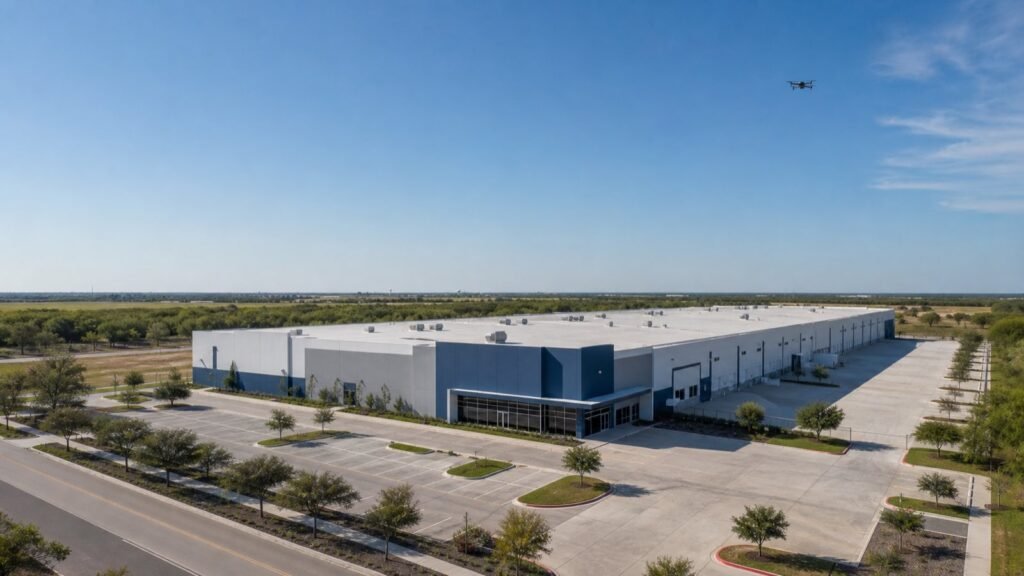
Short answer: aerial video is most useful to an industrial facility when it is planned as a controlled marketing-documentation project, not as a generic drone shoot. Start with one business goal, define what may and may not be filmed, coordinate with the people who own site access and operations, and give the remote pilot enough information to evaluate the actual location, airspace, weather, aircraft, and work conditions. The resulting footage can communicate scale, location, logistics, recruiting culture, or project progress. It should not be sold as an engineering inspection, a safety audit, or proof that a facility is compliant.
That distinction matters. A beautiful aerial sequence can make a facility feel organized, capable, and easier to understand. It can also create risk when a creative brief ignores active vehicles, overhead lines, workers, restricted areas, nearby airspace, or confidential processes. The best industrial aerial work looks calm because the planning was specific long before the aircraft leaves the ground.
If you are deciding whether aerial footage is even worth adding, begin with Nitro’s drone-video guide for San Antonio businesses. This article goes one level deeper: how an industrial facility can scope the access, safety coordination, approval path, and shot plan for an aerial marketing project without pretending the camera is doing a different professional job.
What industrial aerial video is good at—and what it is not
Industrial facilities are difficult to explain with a single ground-level image. Aerial footage can establish a campus, show how buildings relate to a road or rail access point, reveal the scale of a construction phase, and give a recruitment or customer story a usable sense of place. It is especially valuable when a viewer needs context before they need detail.
But the deliverable needs a defined job. “Get drone footage” is not a brief. A practical brief says what a viewer should understand, which areas are approved for filming, what visual evidence supports that story, and what must remain off camera. That keeps the project useful for marketing while preventing a creative crew from making claims it cannot support.
| Business goal | Useful aerial contribution | Scope boundary |
|---|---|---|
| Recruiting or employer brand | Show the facility exterior, arrival experience, scale, and approved team context. | Do not capture badges, screens, employee information, proprietary processes, or people who have not been cleared for the production. |
| Sales, stakeholder, or website video | Orient a viewer to the campus, logistics, product movement, or project scale before ground footage supplies detail. | Do not use an attractive sequence to imply capacity, throughput, certification, or a business result that the facility has not approved. |
| Construction or expansion update | Capture repeatable wide views and approved milestones for communication and a visual timeline. | Do not represent footage as progress certification, quality control, safety verification, or an engineering finding. |
| Facility-tour content | Connect exterior, approach, and selected operations with a clear story arc. | Do not improvise near active work areas simply because the footage would look dramatic. |
For broader examples of how businesses use aerial media across sectors, see Nitro’s guide to commercial drone applications. The rule for an industrial facility is simpler: use the aerial view to clarify a marketing message, then let subject-matter experts make any technical, safety, regulatory, or engineering determination.
Marketing documentation is not an inspection
It is tempting to call a high-resolution drone camera an “inspection tool.” In some settings, appropriately qualified teams may use UAS imagery as part of a formal inspection workflow. That is a different scope from a video-production crew filming brand or stakeholder assets.
A marketing video can show a roofline, tank, structure, yard, or construction area. It cannot by itself establish a condition, diagnose a defect, verify a code requirement, clear a safety hazard, or replace an engineer, inspector, owner representative, or facility safety process. If a frame reveals something that deserves attention, the correct action is to route it to the appropriate facility contact—not to turn a creative edit into an inspection report.
| Marketing aerial documentation | Inspection, engineering, or safety work |
|---|---|
| Purpose: explain a facility, project, brand, workforce, or approved milestone to an audience. | Purpose: assess a condition, verify a requirement, identify a risk, or support a technical decision. |
| Deliverables: edited video, approved stills, b-roll selects, and campaign crops. | Deliverables: findings, measurements, records, technical interpretation, and any required sign-off. |
| Approval: marketing, communications, operations, and site-security owners approve what is shown. | Approval: the organization’s qualified technical, safety, compliance, or engineering authority controls the work. |
| Claim standard: visual storytelling only; captions should be accurate and supportable. | Claim standard: governed by the relevant professional, facility, and regulatory requirements. |
That separation protects both the facility and the production team. It also makes the marketing result better: the crew can concentrate on credible visual storytelling instead of inventing technical conclusions. If the central decision is whether to build an internal production capability or bring in a specialist, Nitro’s industrial video outsourcing guide is the more relevant companion read.
Begin with a site-specific filming brief
Before the shoot date is placed on a calendar, write a one-page brief that can be understood by marketing, operations, the facility contact, and the remote pilot. The goal is not to burden the job with paperwork. It is to stop decisions from being made for the first time next to a launch point.
- Name the audience and business result. Is this for recruiting, a sales deck, a project update, a facility-tour page, leadership communications, or an event recap? One primary audience produces a better shot list than five competing campaigns.
- Define the approved story. List the locations, equipment, signage, project phases, and people that may be shown. Add a short “do not film” list for confidential areas, screens, badges, security features, customer information, or processes that need a separate approval.
- Identify the decision makers. Assign a facility host, operations contact, site-safety contact, marketing approver, and one production-side lead. The remote pilot should know who can answer an access question and who can stop the shoot.
- Map access, not just the subject. Identify an appropriate arrival route, check-in process, launch/landing discussion area, approved viewing positions, parking, restrooms, and any limitations on where crew members may walk. The site controls access; the production team does not create it.
- Describe operating conditions. Note work shifts, deliveries, traffic patterns, contractors, elevated work, shutdown windows, special events, and any conditions that could make a particular sequence inappropriate. These are planning inputs, not a substitute for the facility’s own safety program.
- Write the shot purpose beside every shot. “Wide exterior to establish scale” is useful. “Fly around until it looks cinematic” is not. A clear purpose gives everyone a safe alternative when a preferred angle cannot happen.
- Agree on review and data handling. Decide who sees raw footage, who selects final clips, whether sensitive areas must be removed, and how long raw files should be retained. Industrial footage can show more context than a public-facing campaign needs.
A location conversation should occur before shoot day whenever practical. Nitro’s location-scouting process is useful for the production side, but the facility should remain the authority on access, on-site rules, and the parts of the business that are not appropriate to record.
Coordinate safety and access without turning a video crew into the site safety authority
Industrial sites can change quickly. Vehicles move, contractors arrive, weather shifts, work zones relocate, and a “quiet” portion of a property becomes active. The production plan should therefore include a live coordination step on the day—not a promise that a preplanned route is automatically safe to fly.
The facility’s normal safety and operations process should control site access and worker coordination. The remote pilot in command remains responsible for the UAS operation under the applicable FAA framework and should have a clear go/no-go and abort decision. Those roles complement one another; neither replaces the other.
For example, a site contact may identify active vehicle routes, elevated work, restricted spaces, or a shift change that makes a planned exterior pass inappropriate. The remote pilot may then decide that the safest choice is to reposition, shorten the sequence, substitute a ground shot, wait, or not fly. The business outcome should not depend on forcing one dramatic aerial angle.
The National Institute for Occupational Safety and Health has noted that drones may introduce workplace hazards around workers and that safety professionals should proactively assess and manage those risks. That is a reason to plan with the facility, not a reason to copy a generic checklist into every site. OSHA’s UAS materials are written for OSHA’s own operations and do not govern a private marketing team, but they illustrate why a qualified mission plan, preflight review, communication, and an abort path matter in workplace environments.
Useful discussion prompts for the facility and pilot include:
- Where are people, moving vehicles, cranes, antennae, cables, exposed edges, or other changing conditions likely to be during the intended window?
- Who will notify affected personnel, and how will the crew know that site conditions have changed?
- What area is approved for the crew to stand in, and what areas remain off limits regardless of the shot list?
- How will the team communicate if the facility uses radios, escorts, visitor rules, or access checkpoints?
- What is the fallback if an approved aerial shot becomes inappropriate: a ground angle, a later window, or an omitted sequence?
None of those questions replaces a site-specific hazard assessment, legal advice, or the pilot’s regulatory review. They are simply the level of coordination a facility should expect before a camera aircraft is used around active operations.
Ask the FAA questions early, not after the crew arrives
For work or business aerial filming in the United States, the responsible pilot needs to evaluate the operation under the current FAA framework. The FAA’s commercial-operator guidance explains the Part 107 path and identifies core responsibilities for commercial operators of small UAS. The exact requirements depend on the aircraft, location, people and property involved, airspace, time of day, and planned operation.
That is why a marketing manager should not promise a flight in a proposal or creative brief. Instead, ask the pilot how the location and operation will be reviewed. The FAA’s current Part 107 overview says that a remote pilot certificate or direct supervision by a certificated remote pilot is required to operate the controls under Part 107. It also emphasizes preflight responsibility and the obligation to avoid manned aircraft.
Airspace is a separate question from the facility’s permission. A property owner can approve filming on its grounds, yet the operation may still require the pilot to obtain airspace authorization or adjust the plan. The FAA’s Part 107 airspace-authorization page describes LAANC and FAA DroneZone pathways. The pilot should confirm the current requirements and timing for the exact site rather than relying on a map screenshot shared weeks earlier.
Remote ID is another item to verify for the actual aircraft and operation. The FAA explains that drones required to be registered, or that are registered, must operate in accordance with the Remote ID rule, with specific registration treatment for Part 107 devices. See the FAA’s Remote Identification guidance for the current rule and exceptions. Operations involving people, moving vehicles, night conditions, or other complexity can introduce additional conditions; do not collapse those decisions into a one-line “licensed and insured” promise.
This article is not a legal or regulatory checklist. The safe operating choice is the one the responsible pilot makes after evaluating current FAA guidance and the real conditions at the site. If you want background on what a Part 107 path involves, Nitro’s drone-pilot license guide is a related overview, but current FAA material should take priority over a blog post whenever an operation is being planned.
Build a shot plan around decisions a viewer needs to make
Aerial footage has the most value when it answers a question for the viewer. Before writing a shot list, write the business question each sequence should answer. This prevents the common problem of collecting attractive footage that cannot survive the final edit because no one knows why it was filmed.
| Viewer question | Potential sequence | Safer fallback if conditions change |
|---|---|---|
| Where is this facility and how large is the operation? | Approved wide exterior establishing view with access context. | Ground-based exterior sequence, licensed map graphic, or an approved still. |
| How do the buildings, yard, and logistics areas relate? | Slow, approved overview that creates orientation without exposing sensitive routes. | Ground gimbal movement, site diagram, or a static approved overlook. |
| What does a customer or new employee experience on arrival? | Exterior arrival, signage, entrance, and transition to approved ground footage. | Ground arrival sequence with a controlled camera position. |
| What progress has been made on a project? | Repeatable approved overview that is labeled as visual documentation. | Approved ground photographs or a project-manager supplied update graphic. |
| What makes the work feel capable and real? | Authorized team, process-context, and exterior detail shots supported by ground cameras. | Interview, still imagery, or archival approved footage. |
Use aerial footage for scale, orientation, and transitions. Use ground cameras for faces, interviews, small details, equipment controls, and moments where a closer perspective would create unnecessary risk or ambiguity. Nitro’s guide to handheld versus stabilized movement can help choose the ground-camera complement; the best edit rarely asks one tool to carry the entire story.
A practical industrial shot-list skeleton
- Approved exterior establishing view that identifies the facility’s scale and setting.
- Approach or departure context that is cleared by the site and does not expose restricted security details.
- Wide orientation of buildings, yard, access, or project zones from an approved vantage point.
- One or two carefully selected exterior details that support the story without pretending to inspect equipment.
- Approved logistics or project activity only when the facility and pilot agree that conditions allow it.
- Ground-level transition to a person, product, process, or interview that explains what the aerial sequence cannot.
- Alternative sequence for weather, airspace, activity, or access changes.
Each item should have a purpose, an approval owner, and a fallback. That is enough planning to produce a disciplined video without building a fantasy flight path that the crew feels pressured to execute.
Plan the edit, approvals, and data handoff before flight day
Industrial aerial footage often contains more than the final video needs. A wide exterior may reveal neighboring property, vehicle patterns, gate locations, worker activity, customer identifiers, or proprietary process context. The facility should decide who receives raw footage, who may access it, what requires review before public release, and whether any sequence must be removed from the project archive.
A sensible marketing deliverable can include an edited brand or recruitment cut, several short social crops, approved still frames, and a clearly labeled b-roll folder. What matters is that the handoff does not imply a technical record or inspection package. If the client wants formal documentation beyond marketing assets, that should be a separately scoped project with the appropriate professionals and controls.
For a broader local corporate-content structure, see Nitro’s corporate video-production guide for San Antonio. The same principle applies here: distribution and approval should be planned alongside production, not tacked on after a crew has captured material the company cannot safely use.
Questions to ask before hiring an industrial aerial video team
- Who is the remote pilot in command, and how will that person evaluate the exact location, date, aircraft, and intended operation?
- How will the team confirm airspace, Remote ID, weather, and any other FAA-related conditions that apply to this flight?
- What information do you need from our operations, site-safety, security, and marketing contacts before shoot day?
- What areas, people, processes, and details should be explicitly excluded from the shot plan?
- What is the go/no-go and abort process if site activity, weather, airspace, or access changes?
- How will the crew coordinate with our site host and affected personnel without disrupting active work?
- How do you distinguish the marketing-video scope from inspection, engineering, safety, or compliance work?
- Who receives raw footage, how is it labeled, and who approves final public-use clips?
- Which ground-camera shots or graphics will replace a planned aerial sequence if it is not appropriate to fly?
The strongest answer is not “we can fly anywhere.” It is a calm explanation of the information the team needs, the decisions it will verify, and the alternatives it will use if the flight does not make sense on the day.
When aerial video is the wrong tool
Do not add a drone just because a facility is large. Skip the aerial scope when the business story depends on close process detail, access and approvals are too limited, the active conditions are not appropriate, or the project really requires inspection or technical documentation. A strong ground-based production, approved stills, a diagram, or a leadership interview can tell the story more honestly.
Aerial footage should also be removed from the plan when the pilot’s current evaluation says no. That is not a failed production day; it is the team protecting people, the facility, and the final project. Good industrial video is the result of good judgment, not the number of flight minutes captured.
Bottom line
Plan aerial video for industrial facilities as a precise marketing project: one audience, a defined message, approved access, a realistic shot list, a facility-led coordination process, and a pilot-led operational decision. Use the footage to show scale and context. Use qualified experts for inspection, engineering, and safety determinations. When the aerial plan cannot happen, let the story succeed with a prepared ground-based alternative instead of forcing the shot.
Sources and operational limits
The sources below support the article’s high-level FAA and workplace-planning context. They do not replace site-specific review, current FAA guidance, legal advice, a facility safety plan, engineering review, or the responsible pilot’s decision.
- Federal Aviation Administration: Certificated Remote Pilots including Commercial Operators — commercial Part 107 context and operator responsibilities; accessed July 17, 2026.
- Federal Aviation Administration: Small Unmanned Aircraft Systems Regulations (Part 107) — current operating overview, preflight responsibility, and airspace context; accessed July 17, 2026.
- Federal Aviation Administration: Part 107 Airspace Authorizations — current LAANC and FAA DroneZone authorization pathways; accessed July 17, 2026.
- Federal Aviation Administration: Remote Identification of Drones — current Remote ID and Part 107 registration context; accessed July 17, 2026.
- NIOSH: Can Drones Make Construction Safer? — workplace-risk context and the value of proactive risk management; accessed July 17, 2026.
- OSHA: Use of Small Unmanned Aircraft Systems — public-agency operational-planning context; accessed July 17, 2026.


