 Skip to content

Disclosure: This guide contains no affiliate links or product recommendations. It is a service-planning resource.
Manufacturing video production is not a camera-package decision first. It is a planning decision made inside a live facility, where access, safety boundaries, confidential processes, and useful outputs all matter at the same time. A polished film that cannot be approved for a sales page, used in a training module, or safely captured in the first place is not a useful business asset.
This buyer’s checklist helps a manufacturing marketing, operations, or people leader scope one purposeful shoot day. It focuses on the questions to settle before a crew arrives: what the footage must help someone decide, where filming is allowed, who can approve it, and how the approved master footage can serve sales, training, and recruiting after the shoot. It is not a plant safety plan. The facility’s authorized representatives set all safety, access, PPE, and stop-work requirements.
For a broader view of business-video formats, see Nitro’s corporate video production guide. This page is narrower: it is a practical buyer brief for a real operating environment.
The short version: a manufacturing video buyer’s checklist
- Name the business decision the footage must support before listing shots.
- Give the facility one owner for access, restricted zones, and filming approvals.
- Separate general capability footage from processes, people, screens, or product details that require extra review.
- Build a shot list around an approved use: sales proof, training clarity, recruiting context, or a defined combination.
- Decide who signs off on the footage and how captions, cutdowns, and final files will be reviewed.
The checklist sounds simple because it is meant to be used before details multiply. It prevents a common failure mode: a team spends time arranging a shoot, then discovers on the day that the most persuasive machine, process, workspace, or interview subject cannot be filmed or cannot be released. Good preparation makes the production day smaller, safer to manage, and more reusable.
1. Start with the business job, then prioritize the footage
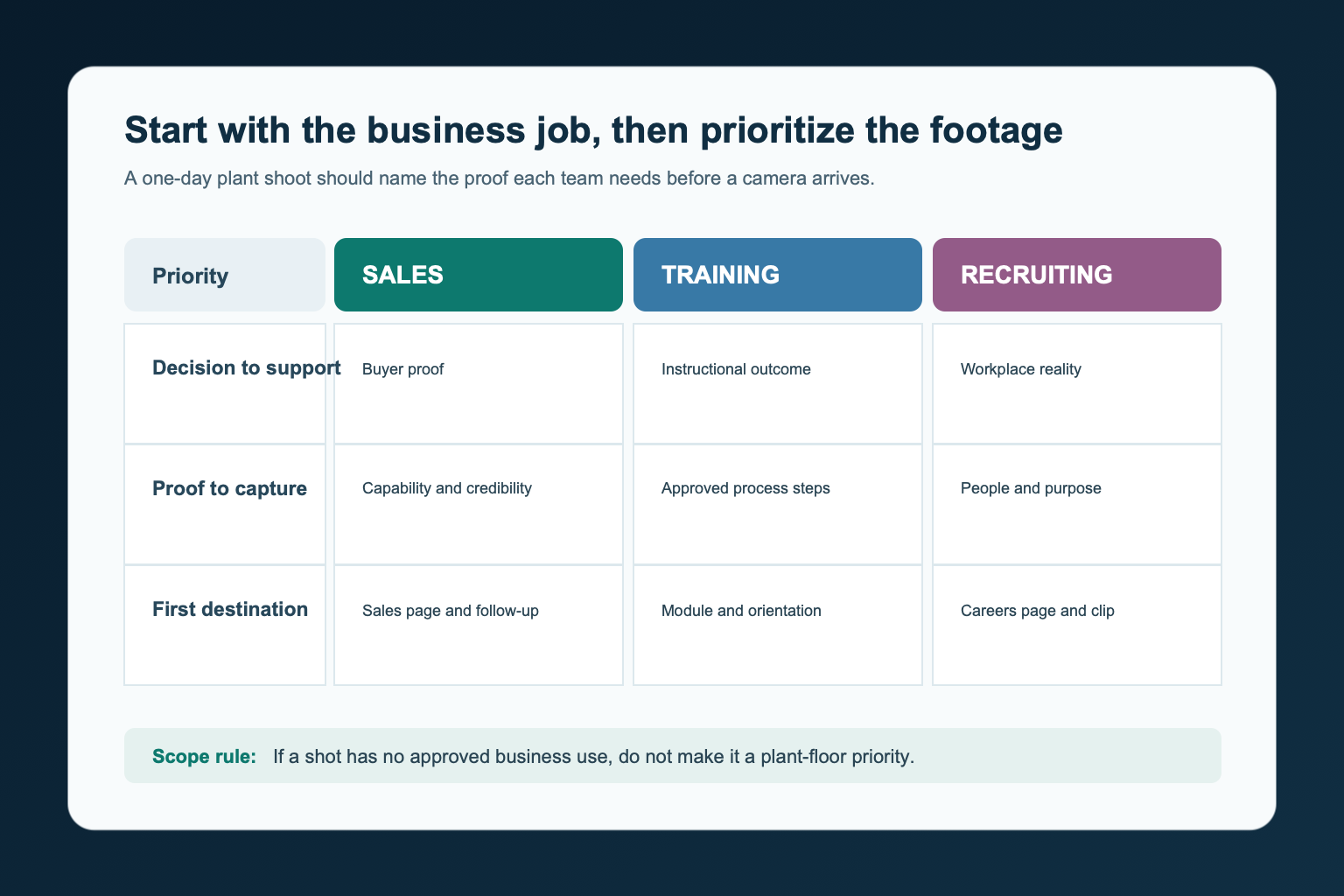
Ask one sentence first: What should a viewer understand or do after watching this? “We need a company video” is too broad to guide access decisions. “A prospective buyer should understand how our quality process supports a specific capability” is more useful. “A new operator should recognize an approved process step” and “a candidate should see the working environment without exposing restricted activity” are different jobs again.
That choice tells everyone what deserves time on the plant floor. Sales footage may need proof of capability, standards, people, and outcomes. Training footage may need a controlled sequence, a clear subject-matter owner, and much tighter approval of what is shown. Recruiting footage may need a credible sense of the workplace and team, without treating employees as anonymous background. A single shoot can support more than one function, but only when each function has a named use and a release path.
Make the first destination explicit
For every planned sequence, write the first place it will be used. A capability-page section, a sales follow-up clip, an employee-orientation module, or a careers-page asset each creates a different editorial standard. This prevents “we can probably use it somewhere” from becoming the only reuse plan. It also makes it easier to decide when a shot is not worth the additional access coordination.
If the production must demonstrate industrial infrastructure rather than general brand positioning, Nitro’s guide to aerial video for industrial facilities is a useful companion. It covers a distinct production context; it does not replace the site’s own access and authorization process.
2. Turn the business outcome into an approval-ready shot list
A buyer’s shot list should be written as evidence, not camera jargon. Instead of “get b-roll of the floor,” identify what the viewer needs to see and why it can be shown. For example, an approved sequence might be “wide environmental view that establishes the scale of the operation,” “an authorized subject explaining a quality checkpoint,” or “a close-up of a non-sensitive finished result.” The facility team can then assess the real risk: visibility of proprietary details, safety restrictions, customer identifiers, screens, labels, live workflows, or people who should not appear.
Give each planned shot four fields:
- Business use: the page, module, campaign, or recruiting moment it supports.
- Location and timing: the area, shift, process state, and escort requirement.
- Approval owner: the person who can say yes, ask for a revision, or say no.
- Restriction: what must not be shown, named, recorded, or implied.
That format is useful because it turns a creative request into a decision document. It also prevents a production partner from guessing whether a visually interesting process is appropriate to capture. The buyer should decide in advance how the team will handle last-minute changes: a backup shot, a different angle, a no-film zone, or a defer-and-review decision. Those choices are normal in an operating facility and are better treated as part of the scope than as surprises.
3. Put access, safety, and release authority on one map
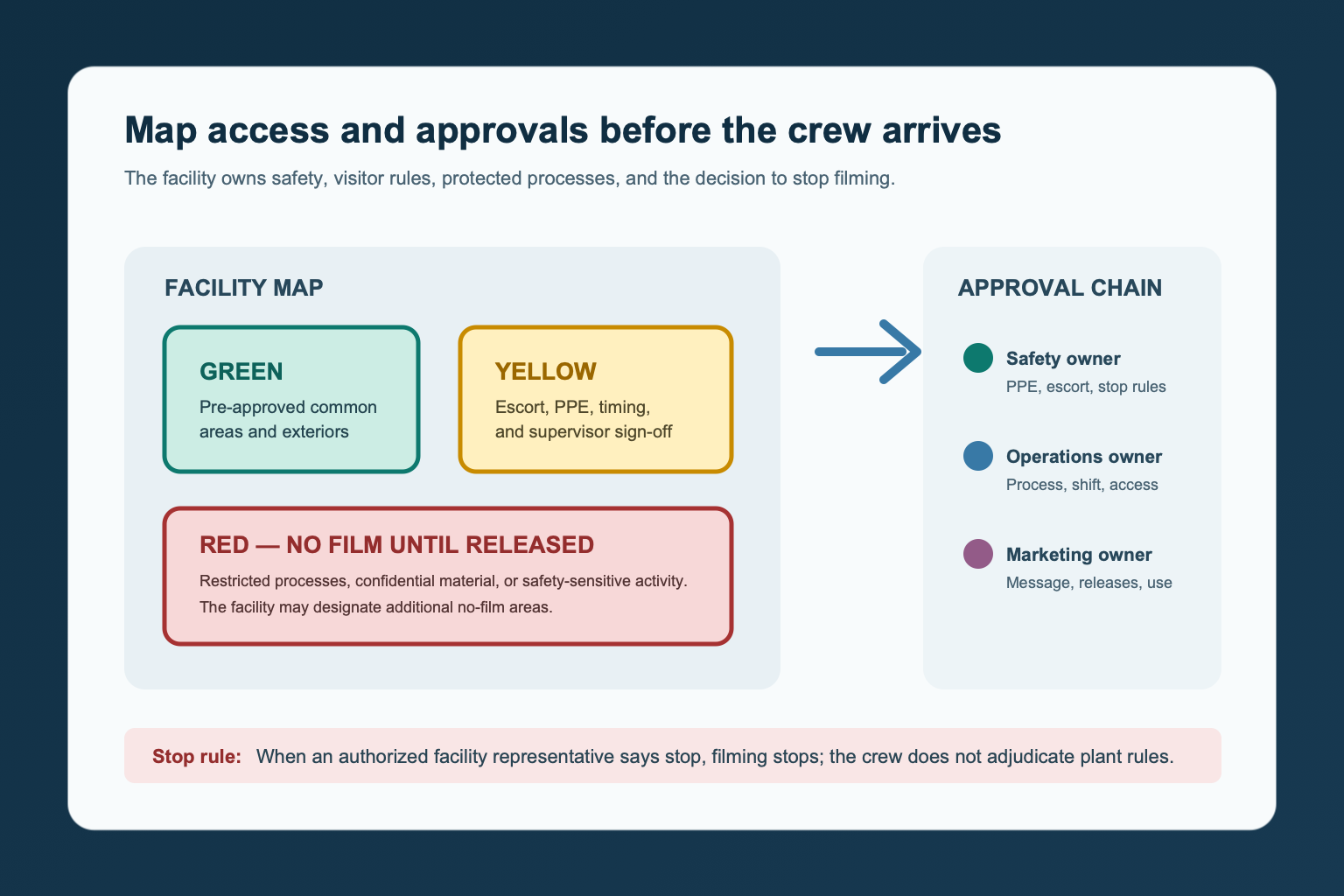
Video teams need a route through the day, but the facility needs a route through its own responsibilities. Name the operational owner, safety contact, marketing or communications owner, and any process, quality, security, or people leader whose review is required. The goal is not to create a longer approval chain; it is to avoid asking the wrong person for a decision when production time is limited.
OSHA’s safety-management guidance emphasizes the value of worker participation in identifying hazards and improving the safety and health program. In practical production planning, that means the people closest to the work can flag conditions, access boundaries, and changes that a marketing brief will not capture on its own. Management leadership also matters because site rules need visible authority, not an informal assumption. See OSHA’s guidance on worker participation and management leadership for the broader safety-management context.
Decide where a camera must stop
A useful plan includes no-film decisions, not just approved locations. Common triggers include active hazards, confidential work, customer information, employee privacy, security controls, unapproved signage, and a process owner’s request to defer. Record the rule and the owner in writing. On the day, the facility representative should be empowered to stop or redirect work without debate. That keeps the crew aligned with the actual authority on site and gives the marketing team a clean record of why a sequence was not captured.
4. Scope the production day around operating reality
Manufacturing schedules are real constraints, not production inconveniences. A camera-ready window may depend on changeovers, material availability, an authorized operator, a clean area, a maintenance pause, a customer visit, or a shift handoff. Build the schedule with the person who understands those conditions. Ask for the earliest realistic arrival process, where equipment can be staged, how escorts will work, when normal work cannot be interrupted, and what contingency exists if a process is unavailable.
The buyer should also define how the crew will work in the space: required orientation, check-in process, approved walk paths, PPE requirements determined by the site, communications method, and where a review can happen without blocking operations. Do not turn a shot list into a promise that every shot will be completed. Treat it as a prioritized plan with an agreed fallback. The highest-value approved proof comes first; nice-to-have visuals follow only if the facility conditions allow them.
For sales-focused projects, a formal comparison of production partners can help keep these questions from becoming subjective. Nitro’s guide to choosing a B2B video production agency offers a separate decision framework. Use the brief here to assess whether a prospective partner can translate the facility’s constraints into a practical shoot plan.
5. Plan reuse before the master footage is captured
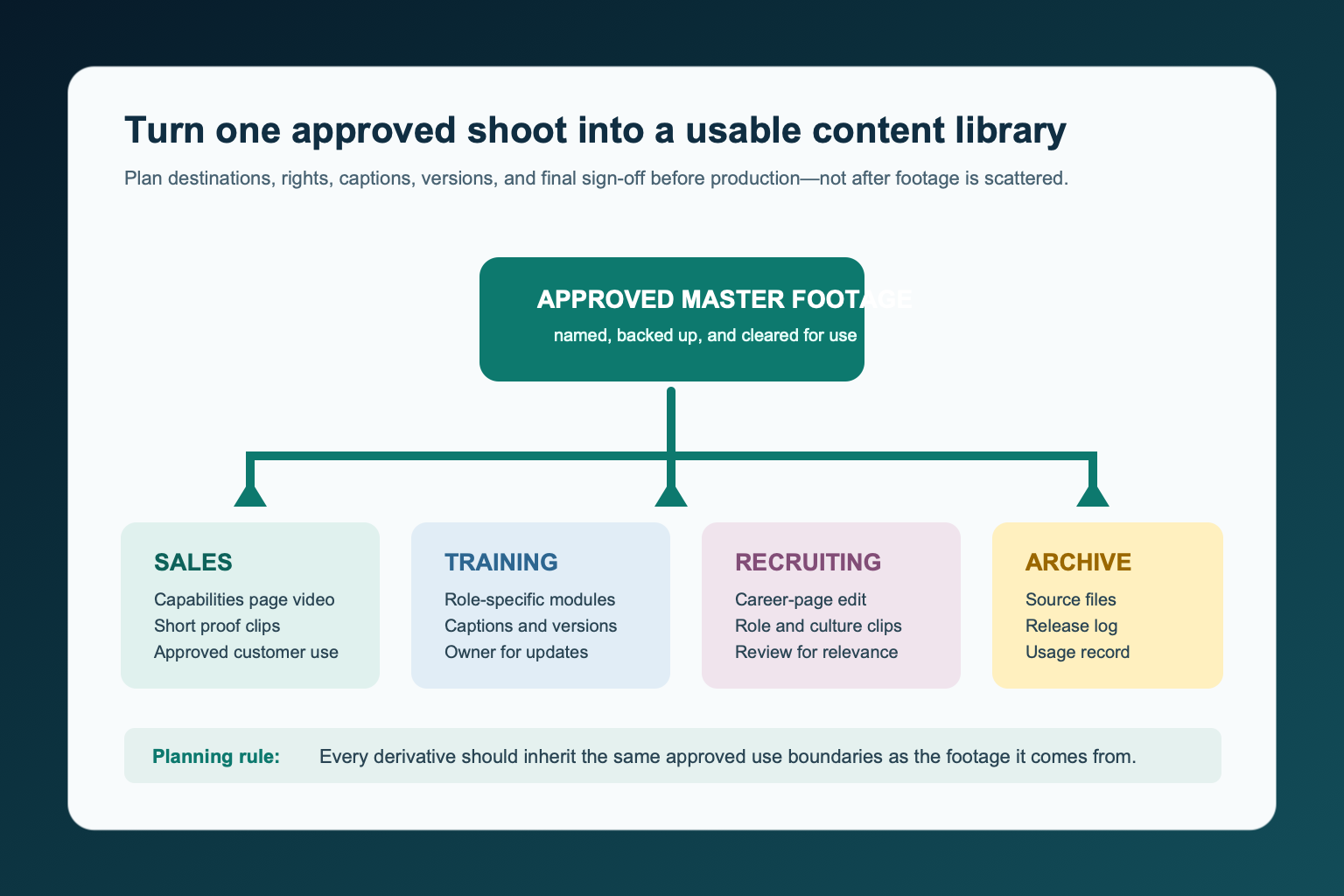
The strongest reason to coordinate a manufacturing shoot is not simply to make a single long video. It is to create an approved library that can support a small number of defined destinations without repeatedly reopening plant access. That does not mean every clip is suitable everywhere. It means the buyer assigns a first use, retains source and approval context, and requests variations only where they add a real business use.
For example, a capabilities-page edit may use a concise narrative and proof of the operation. Sales follow-ups may need shorter, buyer-specific clips. Training content may require a more literal sequence and a different reviewer. Recruiting clips may emphasize work, people, and environment while avoiding claims that cannot be supported. Assigning those jobs before the shoot helps the team capture the right framing, interview prompts, process context, and alternate takes.
Include captions and review in the deliverable plan
Captions are not an afterthought to add once a video is posted. The W3C describes captions as synchronized text for speech and non-speech audio, and notes that automatically generated captions need accuracy review. For a buyer, that means assigning a reviewer for terminology, names, acronyms, and important process language before release. See the W3C captions guidance for the accessibility rationale.
Keep a simple release record with the file version, approved destinations, reviewer, and date. If a later edit introduces a new claim, a new process view, or a new use, route it through the appropriate review rather than assuming that original approval travels automatically. For a practical content-reuse framework, see Nitro’s guide to repurposing a B2B video shoot.
6. Put the buyer brief on one reviewable page
A usable brief does not need to be a long creative document. It needs to let the people with authority make decisions before production time starts. Put the project objective at the top, followed by the intended audience and the first destination for the footage. Then include the scheduled filming windows, primary facility contact, safety and operational contacts, approval owner, restricted topics, and a prioritized shot list with an alternate for any sequence that may be unavailable.
Below that, list the practical decisions that can cause avoidable rework: interview participants and their approvals, brand or customer names that cannot appear, screens or labels that must be cleared, audio restrictions, parking and staging instructions, delivery formats, captions, and the final review route. The point is not to predict every condition. It is to distinguish what is authorized from what remains a question. A production partner can plan around an open question; it cannot responsibly treat silence as permission.
Send that page to the marketing and facility owners early enough for them to amend it. When the scope changes, update the same brief rather than creating a separate informal version. The resulting document becomes a handoff tool for the crew, a release reference for the marketing team, and a record of why a planned visual was captured, changed, or removed.
7. Choose a partner by the quality of the planning conversation
A manufacturing video partner should be able to ask good operational questions before proposing a treatment. Look for a team that distinguishes creative ambition from authorized access, treats site representatives as decision-makers, and explains how it will record feedback without slowing down the workday. It should be comfortable with a change in the plan when the facility says a process, person, or location is not available.
Use these questions in a selection call:
- How will you turn our business objective into an approval-ready shot list?
- What information do you need from safety, operations, quality, and marketing before the day?
- How do you prioritize the schedule if access changes during the shoot?
- What will the review process cover for interviews, process footage, captions, and cutdowns?
- Which deliverables are included, and which use cases should be planned separately?
There is no universally correct production package for a plant tour, training piece, or sales story. The better choice is the partner and scope that make the approved business job, facility boundaries, and release process legible before production begins.
Frequently asked questions
What should be in a manufacturing video brief?
Include the audience and business objective, the first destination for each major sequence, site contacts and access rules, the approval owner, no-film or review-sensitive topics, timing constraints, and the deliverables that will be reviewed. Keep it specific enough for a facility team to make real decisions.
Can one shoot support sales, training, and recruiting?
It can, when each use is named early and the footage is captured and released for that use. Treat the three outputs as related projects with different viewers and reviewers, not as interchangeable edits of the same material.
Do we need to buy cameras or production gear for this?
Usually the buyer’s decision is about production scope, approval process, and the right service partner—not an affiliate-style equipment comparison. The useful next step is a clear brief and a conversation about what can be responsibly captured in the facility.
Bring a usable brief to the first production conversation
A good manufacturing video begins with an honest constraint map: what the audience needs, what the facility can authorize, and what the team can reuse after final review. If you are planning an industrial, corporate, or B2B production project, contact Nitro Media Group with the intended business use, facility location, approval contacts, and any known restricted areas. That gives the first scoping conversation the information needed to discuss a practical production plan.


