 Skip to content
Photos vs videos on social media is the wrong argument if you treat it like a cage match. Video usually wins discovery and motion-based attention. Photos often win trust, proof, clarity, and local authenticity. Carousels can win saves and education. The smart move is not picking one format forever. The smart move is giving each format a job.
For 2026, the practical answer is this: use video when you need reach, personality, motion, process, explanation, or short-form discovery. Use photos when you need proof, portfolio strength, people, products, location credibility, or fast scanning. Use carousels when you need step-by-step education, comparisons, checklists, and save-worthy posts.
- Quick answer
- Format decision map
- When video wins
- When photos win
- When carousels win
- Platform differences
- Content mix
- Local brand strategy
- FAQ
Quick Answer: Do Photos Or Videos Get More Engagement?
Video tends to be stronger for reach and discovery because motion stops the scroll and short-form platforms are built around video consumption. Photos can outperform when the audience already cares about trust, quality, local proof, products, people, and before/after results. Carousels can outperform both when the user wants a useful breakdown they can save.
| Goal | Best first format | Why | Watch this metric |
|---|---|---|---|
| Reach new people | Short video | Movement, hooks, and platform distribution help discovery. | Views, watch time, completion, profile visits. |
| Build trust | Photos | Real people, real work, and clean proof are easy to scan. | Saves, comments, site clicks, inquiries. |
| Educate | Carousel | Step-by-step posts create saves and repeat viewing. | Saves, shares, carousel completion. |
| Sell local services | Mix | Video shows process; photos prove quality; carousels answer objections. | Qualified leads, calls, form submissions. |
| Retarget warm audience | Photo + video | Recognition and repetition matter more than format purity. | Click-through rate and conversion quality. |
Choose The Format By The Job

The format should serve the message. If the message is “watch this transformation happen,” video is probably the better first move. If the message is “look at the quality of this finished work,” photos may be cleaner. If the message is “here are five mistakes to avoid,” a carousel can beat both because people can save it and come back later.
This is where a lot of business accounts get stuck. They hear video is important, so every post becomes a video. Then they wonder why the feed feels exhausting. Or they love polished photos, so every post becomes a gallery and nobody sees the process. Format variety is not a compromise. It is how you avoid asking one content type to do every job like an overworked intern.
When Video Wins Engagement
Video wins when motion matters. That includes behind-the-scenes work, transformations, process, testimonials, event energy, product demonstrations, creator personality, education, and anything where the viewer needs to feel movement or hear tone. Video also gives you more chances to earn attention through pacing, captions, audio, camera movement, and rhythm.
Video is best for discovery
Short-form video is often the best format for reaching people who do not already know you. It can package a useful idea, visual proof, and personality into a small attention window. The catch is that the first seconds have to work. If the opening is sleepy, the format will not save you. That is why the video retention benchmark guide matters before you blame the platform.
Video is best for process and personality
If your work benefits from showing how something happens, use video. A real estate shoot, commercial setup, event recap, product demo, editing breakdown, lighting change, client testimonial, or local business story all become more believable when people can watch the process instead of only seeing the polished final frame.
Video can still lose when the job is proof
Video is not automatically better. If the viewer needs to inspect the final result, compare details, or quickly understand quality, a photo or carousel may be stronger. Do not make people scrub a Reel just to see the one frame they wanted. That is how you turn engagement into hide-and-seek.
When Photos Win Engagement
Photos win when the viewer needs proof fast. Finished work, product details, team credibility, venue atmosphere, before/after comparisons, food, real estate, events, portraits, construction progress, local business moments, and social proof can all perform beautifully as photos because the viewer understands the point instantly.
Photos are trust assets
A strong photo can say, “This is real. This happened. This is our quality level.” That matters for local service businesses, hospitality, events, real estate, professional services, and brands that need credibility more than viral reach. A photo may get fewer raw views than a video and still create a better lead.
Photos are easier to scan
People can inspect a still image quickly. That is valuable when you need the viewer to notice lighting, composition, facial expression, venue detail, product finish, or before/after quality. Video may show more, but photos can make the key proof impossible to miss.
Photos pair well with strong captions
A photo with a useful caption can become a mini case study: what the client needed, what changed, what the result looked like, and how the viewer can think about their own situation. That is engagement with business value, not just a like from someone who recognizes the background wall.
When Carousels Beat Both
Carousels are the underrated middle lane. They can combine visuals, education, comparison, and step-by-step structure. For social media engagement, carousels can be especially useful because they invite swiping, saving, sharing, and returning. That is not always as flashy as a viral clip, but it can be more valuable for trust and leads.
| Carousel use case | Why it works | Example |
|---|---|---|
| Step-by-step education | Each slide carries one idea without overwhelming the viewer. | How to plan a video shoot in five steps. |
| Before/after comparison | The user can inspect progress and result at their pace. | Listing photos before and after professional lighting. |
| Mistake lists | Save-worthy and easy to share with a team. | Five reasons your event recap feels flat. |
| Case studies | Combines proof, process, and result. | Problem, approach, production, result, next step. |
| Buying guides | Breaks complex decisions into simple frames. | Camera, audio, lighting, and storage priorities. |
Engagement Quality Matters More Than Format Bragging Rights
A video that gets more views but attracts the wrong people is not automatically better than a photo that gets fewer views and brings in a serious buyer. This is where social media reporting can get a little ridiculous. Everyone wants the easy winner, but business content is not a dunk contest. The goal is not only to make people look. The goal is to make the right people understand, trust, remember, save, click, ask, or buy.
That means the best format depends on the metric that matches the job. If the job is discovery, video may win. If the job is portfolio proof, a photo may win. If the job is education, a carousel may win. If the job is conversion, the winner may be the sequence: a video introduces the problem, a photo proves the result, a carousel answers objections, and a service page closes the loop.

| Engagement type | What it usually means | Format that often helps |
|---|---|---|
| View | The content got attention or distribution. | Short video |
| Like/reaction | Low-friction approval. | Photo or short video |
| Comment | The content invited opinion, identity, or a question. | Video, photo, or carousel |
| Save | The content is useful enough to revisit. | Carousel or checklist post |
| Share/send | The content makes someone think of another person. | Useful video or carousel |
| Click/inquiry | The content created enough confidence for action. | Format sequence plus clear CTA |
For a local business, I would rather see ten qualified site clicks than a thousand passive views from people who will never hire the company. Reach still matters. You need the top of the funnel. But reach without trust is confetti. It looks exciting for a second, then someone has to clean it up.
Platform Differences: Instagram, Facebook, TikTok, YouTube, LinkedIn
Each platform reports engagement differently, and each platform attracts a different mindset. LinkedIn’s post analytics documentation and LinkedIn Page content analytics documentation show how LinkedIn separates discovery, engagement, profile activity, demographics, and video performance. Meta/Facebook video insights documentation points users into Meta Business Suite for video insights. Translation: do not compare platforms by one metric and pretend the job is done.
Use Reels for reach, photos for proof, and carousels for saves. A local service account that posts only Reels can look active but thin. A portfolio account that posts only photos can look polished but quiet. The best mix usually shows work, process, people, proof, and education.
Facebook still matters for local audiences, community sharing, event recaps, testimonials, and older demographics. Photo albums, event highlights, and practical videos can all work. The key is matching the content to how the audience actually uses the platform instead of pretending every channel is TikTok with different furniture.
TikTok-style short video
Short video is strong for discovery, personality, and repeatable series. It is less strong when the final proof needs detailed inspection. Use it to show motion, insight, story, process, and human texture. Then send people somewhere useful when they want the polished result.
YouTube
YouTube can support both short-form and long-form strategy. Shorts can introduce ideas and reach new viewers. Longer videos can educate, rank, build authority, and answer search intent. For Nitro-style content, the best YouTube strategy usually connects Shorts, full videos, blog posts, and service pages instead of treating each upload like an island.
LinkedIn is often better for business proof, POV, case studies, team credibility, and niche expertise than pure trend chasing. A thoughtful photo post or carousel can beat a generic video when the audience is evaluating trust. Video still works, but it should feel useful, not like a brand discovered captions yesterday.
The 50 / 30 / 20 Social Content Mix

A practical starting mix for many local brands is 50 percent video for reach and process, 30 percent photos for trust and proof, and 20 percent carousels for education and saves. This is not a law. It is a starting point that keeps the feed from becoming one-note.
| Format | Role | Post ideas | Primary metric |
|---|---|---|---|
| Video | Reach and motion | Behind the scenes, process, tips, transformations, testimonials. | Watch time, completion, profile visits. |
| Photos | Trust and proof | Finished work, people, events, details, before/after, portfolio moments. | Saves, comments, inquiries, website clicks. |
| Carousel | Education and saves | Checklists, mistakes, case studies, frameworks, comparisons. | Saves, shares, swipe-through rate. |
| Story/live | Relationship and immediacy | Day-of updates, quick polls, reminders, human moments. | Replies, taps, link clicks. |
| Long-form/blog | Authority and search | Guides, comparisons, FAQs, campaign recaps. | Organic traffic, leads, assisted conversions. |
Local Brand Strategy: How Service Businesses Should Use Photos And Videos
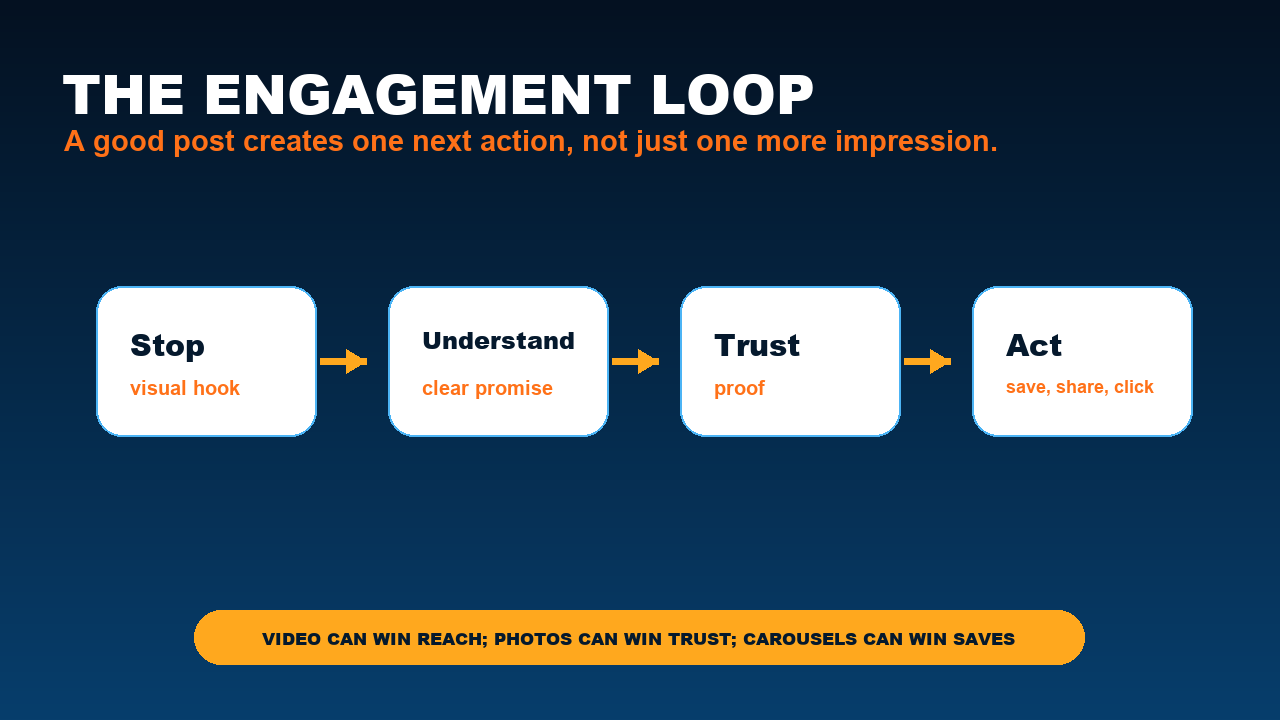
For local service businesses, the format question should be tied to the buyer journey. Cold audiences need a reason to stop. Warm audiences need proof. Ready-to-buy audiences need confidence, clarity, and a next step. That means a good content plan uses more than one format on purpose.
Awareness content
Use video to show the problem, the process, or the personality behind the brand. Quick clips, behind-the-scenes footage, transformations, and useful opinions can pull new people into the orbit. This is where commercial video production and creator-style production can help because motion needs structure, not just movement.
Trust content
Use photos and carousels to show results, team, venue, details, testimonials, finished work, and case-study proof. A clean photo post can be the difference between “they say they do this” and “I can see they do this.” That matters for real estate, events, legal, medical, hospitality, and professional services.
Conversion content
Use a mix: a short video to answer the objection, a photo to prove the result, a carousel to break down the process, and a clear link to the next step. For example, a real estate brand can pair a video walkthrough with photo proof and a practical pricing/resource page like the real estate photography pricing guide. That is a smarter funnel than posting one lonely Reel and hoping the algorithm develops a sales department.
How To Test Photos Vs Videos Without Fooling Yourself
Run format tests in pairs. Do not compare a great video idea against a weak photo dump and declare video the winner. Compare similar topics, similar audiences, similar timing, and similar quality. Then measure the metric that matches the job.
- Same topic: post a short video and a carousel/photo version of the same idea.
- Same audience: avoid comparing boosted content against organic content without labeling it.
- Same quality: a thoughtful photo beats a lazy video; a strong video beats a random gallery.
- Same goal: reach, saves, inquiries, clicks, and leads are not interchangeable.
- Same review window: check early performance and later performance; some content earns slow trust.
A Practical Weekly Format Plan

A good weekly social plan should feel like a rhythm, not a random pile of posts. For many Nitro-style clients, I would build around one anchor video, one trust-building photo post, one educational carousel, and one lighter relationship post. That gives the account reach, proof, usefulness, and human texture without asking every post to perform every job.
Anchor video
Use the anchor video to show process, personality, movement, or a useful point of view. This could be a shoot breakdown, client problem, before/after walkthrough, quick tip, or behind-the-scenes moment. The video should connect to a real business topic, not just “we had a camera and the sun existed.”
Trust photo post
Use a photo post to show quality. Finished work, team, client moment, event detail, location, product, real estate result, or campaign proof can all work. The caption should explain why the photo matters: what problem it solved, what changed, or what the viewer should notice.
Educational carousel
Use a carousel to turn expertise into something save-worthy. Five mistakes, three examples, a checklist, a comparison, or a mini case study can all work. This is where service businesses can stop sounding like everyone else and start showing how they think.
Relationship post
Use a lighter post for culture, community, event energy, client appreciation, or a quick observation. Not every post needs to sell directly. But every post should still fit the brand. Randomness is not authenticity. It is just randomness with awkward studio glare.
| Weekly slot | Format | Job | Example |
|---|---|---|---|
| Monday | Carousel | Teach/save | Five things to prep before a video shoot. |
| Tuesday | Photo | Trust/proof | Finished client image with a short case note. |
| Wednesday | Video | Reach/process | Behind the scenes from a production day. |
| Thursday | Photo or carousel | Objection handling | Before/after, pricing context, or FAQ. |
| Friday | Short video/story | Relationship | Team, event, community, or quick insight. |
Common Format Mistakes That Kill Engagement
The first mistake is using video when a still image would be clearer. If the viewer needs to inspect a result, a room, a portrait, a product detail, or a before/after comparison, do not make them chase the important frame through a moving clip. That is not engagement. That is making the audience do unpaid detective work.
The second mistake is using photos when motion is the proof. If the value is in the transformation, the process, the reaction, the sound, the walkthrough, or the energy of an event, a still image may undersell the point. A photo can show the finish line. Video can show the reason to care about the race.
The third mistake is posting carousels that are just tiny blog posts smashed into slides. Carousels should be scannable. One idea per slide. Clear headline. Useful order. Strong final action. If each slide looks like a screenshot of a terms-of-service update, the save rate is probably not going to become a family legend.
The fourth mistake is judging the format before judging the concept. A weak idea in video form is still a weak idea. A strong idea in photo form can still travel. Before blaming the algorithm or worshipping a format, ask whether the post gave the audience a reason to stop, understand, trust, and act. Format helps, but the idea still has to carry its own weight.
The better habit is simple: define the job before choosing the format. Reach, proof, education, retargeting, and conversion should not all get the same creative treatment. A focused post usually beats a format trend wearing borrowed confidence.
If you want the content to support real business goals, connect it back to your site, offers, service pages, and internal resources. The creator gear playbook, video retention benchmark guide, and Nitro marketing and video services are all part of that bigger system: useful content, not random posting.
FAQ
Do videos get more engagement than photos?
Often, videos get more reach and discovery, especially in short-form feeds. But photos can drive stronger trust, proof, and local buyer confidence. Engagement quality matters as much as engagement volume.
Are photos still worth posting on social media?
Yes. Photos are still powerful for proof, portfolios, local credibility, products, people, events, and before/after results. A strong photo can be easier to inspect and trust than a fast video.
When should a business use carousels?
Use carousels for education, step-by-step content, mistakes, comparisons, case studies, checklists, and save-worthy posts. They are especially useful when the viewer needs structure instead of entertainment.
What is the best content mix for local brands?
A strong starting point is 50 percent video, 30 percent photos, and 20 percent carousels. Adjust based on platform, audience, and business goals.
Should every business chase Reels?
No. Reels can be useful, but the goal is not to become a content slot machine. Use Reels when motion, reach, personality, or process matters. Use other formats when proof, trust, or education matters more.
Bottom line
Photos vs videos is not a winner-take-all fight. Video is usually best for reach and process. Photos are often best for proof and trust. Carousels are excellent for education and saves. The best content plan uses all three with a job attached.


